


 Download:




-
Introduction: Clostridium botulinum (C. botulinum) produces botulinum neurotoxins (BoNTs), the causative agents of botulism, a severe neuroparalytic disease prevalent in northwest China. Recent foodborne botulism outbreaks linked to commercially produced, vacuum-packaged, ready-to-eat foods were traced to raw meat contaminated with C. botulinum spores originating from soil, highlighting an emerging public health concern related to environmental reservoirs. However, genomic information on environmental isolates from high-incidence regions remains limited.
Methods: A total of 23 C. botulinum strains isolated from soil and soybean samples in northwest China were sequenced in 2024. Genomes were analyzed for plasmids, prophages, antibiotic resistance genes, virulence factors, and bont. Evolutionary relationships and adaptive features were investigated via phylogenetic and functional analyses.
Results: The 23 isolates were classified into four BoNT subtypes [A5(B3), B2, B3, B4] and clustered according to subtype and geographic origin. Isolates from Qinghai formed distinct branches. Functional annotation revealed subtype-specific metabolic variations, particularly in carbohydrate metabolism. Although all isolates contained conserved bont clusters, some exhibited transposase insertions. One subtype A5(B3) isolate harbored bont within an incomplete prophage.
Conclusion: These preliminary insights into environmental C. botulinum virulence, ecological adaptation, and evolutionary characteristics in northwest China provide a foundation for targeted surveillance and the development of preventive strategies against botulism in endemic regions.
-
Clostridium botulinum (C. botulinum) is a Gram-positive, spore-forming, and anaerobic bacillus that is ubiquitously distributed in soils, aquatic sediments, and animal feces, posing a potential risk for foodborne and environmental exposure. Botulism is a severe neuroparalytic disease caused by botulinum neurotoxin (BoNT) produced by C. botulinum. BoNTs are among the most potent biological toxins and are classified into serotypes A–G, with types A, B, E, and F primarily associated with human disease (1).
In China, foodborne botulism (FB) exhibits a distinct geographical distribution, with a higher prevalence in northwestern provincial-level administrative divisions (PLADs) such as Xinjiang, Inner Mongolia, and Qinghai. Traditional dietary habits and local environmental conditions promote C. botulinum proliferation, and outbreaks are frequently associated with consumption of homemade fermented soybean products and dried meat contaminated with soil-derived spores (2–4). Additionally, recent FB outbreaks linked to commercial vacuum-packaged ready-to-eat foods were likely caused by contamination of raw meat with C. botulinum spores in soil, highlighting an emerging public health concern associated with environmental reservoirs (5–6). Most previous genomic studies focused on clinical or food isolates, whereas data on environmental isolates from high-incidence regions in China are scarce.
Here, we sequenced 23 C. botulinum isolates from soil and soybean samples from high-incidence regions in Northwest China and compared their genetic diversity, evolutionary dynamics, and virulence potential of reservoirs linked to human diseases. This study is critical for assessing public health risks and tailoring region-specific preventive strategies.
Twenty-three C. botulinum isolates were collected from Xinjiang (13 isolates, including 11 from soil and two from soybean samples), Inner Mongolia (8 isolates from soil), and Qinghai PLADs (2 isolates from soil) in 2024 (
Supplementary Table S1 ). Genomic DNA was extracted using a Genomic DNA Purification Kit (Promega, Madison, WI, USA). Sequencing was performed by Beijing Novogene Bioinformatics Technology Co., Ltd. (Beijing, China) on an Illumina HiSeq platform (San Diego, CA, USA; 150-bp paired-end; 100× coverage depth). The quality of raw reads was assessed using FastQC (version 0.11.9). Clean reads were assembled de novo using SPAdes (version 4.1.0). Assembly quality was evaluated using QUAST (version 5.3.0; Algorithmic Biology Lab, St. Petersburg, Russia). Genome annotation was performed using Prokka (version 1.14.6; University of Melbourne, Melbourne, Australia). Plasmid sequences were identified using PlasmidFinder. A phylogenetic tree of bont was constructed using the neighbor-joining method in MEGA (version 11.0; Pennsylvania State University, State College, PA, USA), incorporating sequences from the isolates in this study and representative reference strains of subtypes A and B retrieved from GenBank (Supplementary Table S2 ). Core genome single-nucleotide polymorphisms (cgSNPs) were identified using Snippy (version 4.6.0; University of Melbourne, Melbourne, Australia). A maximum likelihood tree was generated using FastTree (version 2.1.10, San Diego, CA, USA) on the Galaxy platform (7). Sequence types were assigned using the PubMLST database. Phylogenetic trees and figures were generated and visualized using the ChiPlot web server (8). Predicted proteins were functionally annotated using the Clusters of Orthologous Genes (COG; https://ngdc.cncb.ac.cn/databasecommons/database/id/37) database, and principal component analysis of the COG category distributions was performed using R (version 4.4.0; The R Project for Statistical Computing, Vienna, Austria). Virulence genes in the Virulence Factor Database (https://www.mgc.ac.cn/VFs/) were identified using BLASTn. Antibiotic-resistance genes were detected using The Comprehensive Antibiotic Resistance Database (https://card.mcmaster.ca/). The 10-kb genomic regions flanking bont were compared using Easyfig (version 2.2.5, Brisbane, Australia). Prophage regions were predicted using the PHASTER web server.The genomes of 23 isolates sequenced and assembled de novo showed sizes of 3.79–4.23 Mb and GC contents of 27.2%–28.3% (
Supplementary Table S3 ). PlasmidFinder revealed no plasmids. Phylogenetic analyses based on bont genes, cgSNPs, and multilocus sequence typing consistently revealed that the 23 isolates clustered primarily according to subtype and sequence type. This included nine subtype A5(B3) and three subtype B3 isolates from Xinjiang; eight subtype B2 isolates from Inner Mongolia and one from Xinjiang; and two subtype B4 isolates from Qinghai (Figure 1). Isolates from Xinjiang and Inner Mongolia formed a closely related genetic cluster (Group I), whereas Qinghai isolates constituted a distinct phylogenetic branch (Group II). Notably, isolates FZSY033106030013 [A5(B3)], FZSY033106030017 (B2), and FZSY033106030015 (B3) exhibited unique sequence types and greater genetic distances from others within the same subtype, suggesting microevolution or distinct ancestral origins. Figure 1.
Phylogenetic analysis of 23 Clostridium botulinum isolates from China. (A) Neighbor-joining phylogenetic tree based on bont nucleotide sequences. (B) Core-genome SNP-based maximum-likelihood phylogenetic tree with a heatmap showing PLAD, sample type, subtype, multilocus sequence type, group, virulence factors, and antibiotic resistance genes. (C) SNP distance matrix illustrating pairwise genetic distances among isolates, with color gradients indicating SNP differences and subtypes.
Note: For (A) Bootstrap values (1,000 replicates) are indicated, with colors representing subtypes.
Abbreviation: SNP=single-nucleotide polymorphism; PLAD=provincial-level administrative division.
Functional annotation assigned the predicted proteins to 23 categories. Excluding proteins with unknown functions, the most abundant categories were transcription, amino acid transport and metabolism, and cell cycle control, cell division, and chromosome partitioning (Figure 2A). Principal component analysis based on COG annotations revealed that the 23 isolates clustered into three major groups. A5(B3) and B3 exhibited functional similarities and were grouped, whereas B2 and B4 formed distinct clusters (Figure 2B). This separation was mainly driven by the categories carbohydrate transport and metabolism, transcription, and amino acid transport and metabolism (Figure 2C). Importantly, FZSY033106030013 [A5(B3)] was positioned closer to the B2 cluster, whereas FZSY033106030017 (B2) was closer to the B3 cluster.
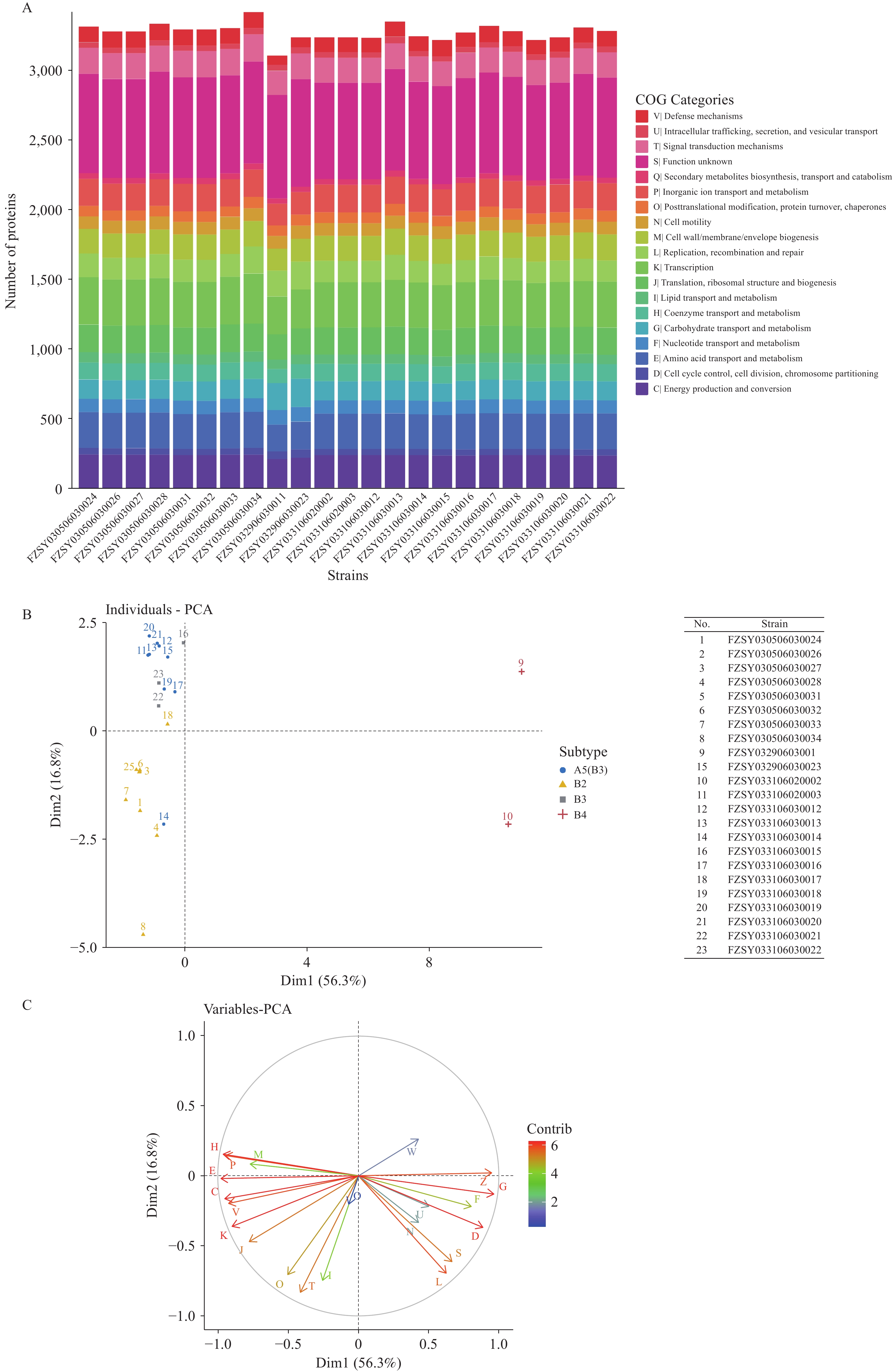 Figure 2.
Functional annotation and PCA clustering of 23 Clostridium botulinum isolates based on COG categories. (A) Stacked bar chart showing the distribution of predicted proteins across 23 isolates, with colors representing COG categories. (B) PCA scatter plot of isolates along the first two principal components, with points colored by subtype. (C) PCA correlation circle plot of COG categories as variables, where arrow length and direction indicate correlation strength and sign, and color intensity indicates contribution magnitude.
Abbreviation: PCA=principal component analysis; COG=clusters of orthologous genes.Five virulence factors and two antibiotic-resistance genes were identified across the isolates (Figure 1B). All isolates carried bont, cloSI, colA, and hemolysin, whereas pfoA was detected only in B4 isolates. cfrC, encoding resistance to the antibiotics phenicol, oxazolidinone, lincosamide, and streptogramin, was present in 20 isolates but absent from both B4 isolates and one A5(B3) isolate (FZSY033106030016); CBP-1, encoding resistance to penicillin β-lactam antibiotics, was found exclusively in the B2 isolate FZSY030506030032.
Comparative analysis of the 10-kb flanking regions upstream and downstream of bont revealed a conserved ha70–ha17–ha33–botR–ntnh–bont cluster in all isolates (Figure 3). A5(B3) isolates harbored complete bont/A5 and a truncated bont/B3. Two distinct gene contexts occurred within the A5(B3), B2, and B3 subtypes, with FZSY033106030013 [A5(B3)], FZSY033106030017 (B2), and FZSY033106030015 (B3) showing arrangements that differed from those of other isolates of the same subtype (Figure 3). Specifically, FZSY033106030013 [A5(B3)] contained a transposase gene and divergent downstream region, whereas FZSY033106030017 (B2) harbored a transposase gene upstream of the cluster. PHASTER analysis identified prophage sequences in all 23 genomes (Supplementary Table S4, available at
https://weekly.chinacdc.cn/ ), with only one isolate, FZSY033106030013 [A5(B3)], containing an incomplete prophage element that carried bont (Figure 4).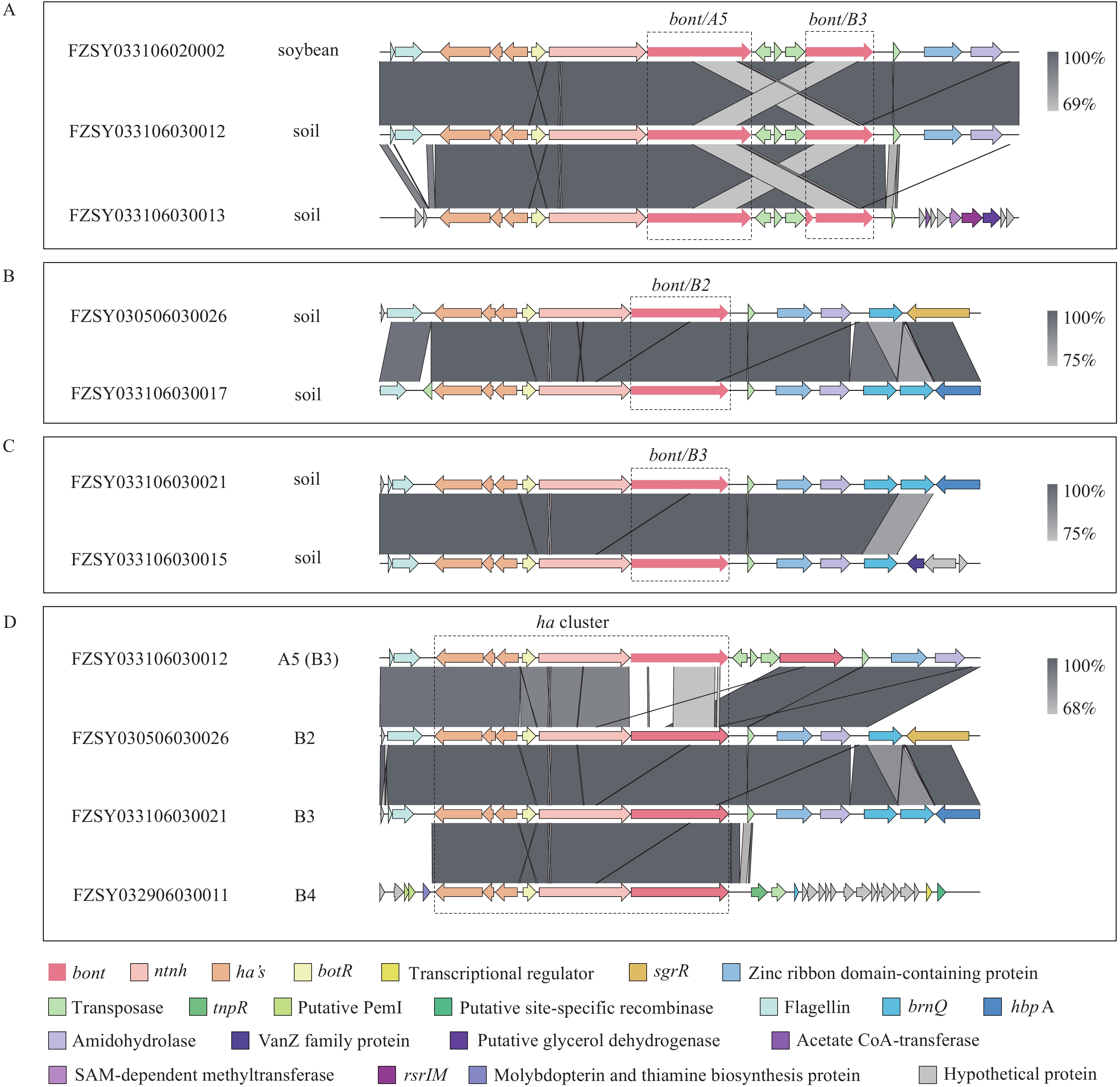 Figure 3.
Comparative genomic context of the 10 kb upstream and downstream flanking regions of bont cluster in 23 Clostridium botulinum isolates. (A) Two distinct gene contexts of subtype A5(B3) isolates. (B) Two distinct gene contexts of subtype B2 isolates. (C) Two distinct gene contexts of subtype B3 isolates. (D) Representative gene contexts of subtypes A5(B3), B2, B3, and B4.
 Figure 4.
Incomplete prophage element carrying bont in the A5(B3) isolate FZSY033106030013.
-
In China, FB cases are predominantly reported north of 30°N, with clear regional variations in the causative foods (9). Homemade fermented soybean products are the primary vehicles in Xinjiang and Inner Mongolia, whereas homemade dried meats are frequently consumed in the Qinghai Plateau (2–3). Notably, recent cases of botulism were linked to commercial vacuum-packed meat and meat products, reflecting a growing concern alongside traditional sources (5–6). These products may be contaminated with soil-derived C. botulinum spores present on raw meat, with anaerobic packaging facilitating spore germination and toxin production. Thus, studies are needed to explore the genomic characteristics of C. botulinum in high-risk regions.
We collected 23 C. botulinum isolates from soil and soybean samples obtained from three Chinese PLADs associated with a high incidence of botulism. Phylogenetic analyses based on bont and cgSNPs revealed four subtypes [A5(B3), B2, B3, and B4] with distinct subtype-specific clusters. Isolates from Xinjiang and Inner Mongolia were genetically distant from those from Qinghai, suggesting geographic differentiation and adaptation to distinct ecological niches influenced by high-altitude, low-oxygen environments (10). Interestingly, atypical sequence types and unexpected cgSNP distances in several isolates indicate recombination or horizontal gene transfer. Importantly, the predominance of BoNT/A5(B3) in soils was consistent with the serotypes reported in historical FB cases from the same regions (11), suggesting that local soils act as environmental reservoirs, contributing to soil-to-food transmission. This concordance highlights the need for stricter hygiene practices in food processing, particularly during the traditional fermentation and preservation of soybean products and meat in these high-risk regions.
Functional annotation further suggested niche-specific metabolic adaptations, particularly differences in carbohydrate metabolism between subtypes, which may influence their persistence in local environments (12). The functional proximity of some A5(B3) and B2 isolates to other subtypes further suggested shared metabolic traits or transitional evolutionary states, possibly facilitated by genetic exchange. These ecological features, coupled with the conserved bont cluster and sporadic acquisition of resistance genes, support the evolutionary stability and genomic plasticity of environmental isolates (13). Moreover, identification of an incomplete prophage carrying bont suggests historical phage-mediated dissemination of toxin genes, although its current mobility remains uncertain (14).
This study had several limitations. First, the relatively small number of strains from the three PLADs may not fully represent the genetic diversity of C. botulinum across endemic regions in China. In addition, the lack of paired food and clinical isolates from outbreaks limits our ability to establish direct transmission pathways from soil to food. Finally, reliance on genomic data without phenotypic validation restricts inferences regarding toxin expression.
We performed genomic characterization of C. botulinum toxin subtypes from soil reservoirs in Northwest China, revealing their genomic diversity and potential ecological adaptations in high-incidence regions. Tailored surveillance and preventive strategies are needed to mitigate foodborne botulism in traditional and industrial settings.
HTML
| Citation: |

|