


 Download:




-
Cadmium is a toxic heavy metal and environmental pollutant that accumulates in soil and enters the food chain (1). Chronic exposure damages multiple organs and systems (2), but its public health burden remains unquantified.
Since 1993, disability-adjusted life years (DALYs) have been the main indicators of disease burden (3). The Global Burden of Disease Study 2023 (GBD 2023) has established DWs covering 590 health states (4). However, the use of DALYs to assess the burden of chronic cadmium poisoning is limited due to the lack of disability weights (DWs). Limited exposure can cause severe, multi-organ damage, demonstrating the phenomenon of “one cause and multiple effects.” The presence of any more health impairments also defines more severe poisoning. Consequently, the actual disease burden of chronic cadmium poisoning remains unclear.
This study aimed to establish DWs of mild and severe chronic cadmium poisoning. Given the expertise of medical professionals in disease recognition (5), they were included alongside the general population.
HTML
-
Disease-specific descriptions of mild and severe chronic cadmium poisoning were developed following China’s National Occupational Health Standards and validated by occupational disease experts. Generic terms were established using the EuroQol 5-dimension plus cognition 3-level (EQ-5D+C-3L) instrument (6) (
Supplementary Table S1 ). Both disease-specific and generic descriptions were validated by occupational disease experts.With reference to the design for determining the DWs of chronic mercury poisoning (7), a severity spectrum of health states was constituted with consideration on methodological requirement and performable feasibility. A severity spectrum of 13 health states was established based on current parameters of DWs for mild vision disorder, diabetes mellitus, breast cancer (disease-free stage without permanent sequelae), mild dementia, severe asthma, coronary heart disease (stage at diagnosis and primary therapy), human immunodeficiency virus/acquired immunodeficiency syndrome (HIV/AIDS; seropositive, asymptomatic), colorectal cancer, stroke moderate impairments (acute incident plus rehabilitation phase), chronic low back pain, quadriplegia, severe depression, and deafness that has cross-cultural/regional stability (8). Disease-specific descriptions were identified through literature reviews and converted to generic descriptions using the EQ-5D+C-3L (6) in consultation with clinical experts (
Supplementary Table S1 ).Descriptions were compared with the lay descriptions used in GBD 2023 (4). Consistency was assessed using the Delphi method (
Supplementary Material ). A mean value ≥3 and coefficient of variation ≤0.35 (9) were considered a consensus. In this study, 12 health states, excluding HIV/AIDS, matched the corresponding descriptions in the GBD 2023 study and were used as anchors for a locally weighted regression model (Supplementary Table S2 ). -
The pairwise comparison (PC) method (
Supplementary Material ) was used as described in previous GBD studies (10). Each PC question presented a brief narrative of the main characteristics of disease-specific and generic descriptions. Demographic data included sex, age, household income, and education level.The survey was conducted from June 2022 to August 2022 in Shenyang City, China. Sample size (n=375) was calculated based on the PC method used in the GBD studies (10), which requires 25 responses per health state; the number was increased to 480 to achieve an 80% response rate.
A total of 552 questionnaires were distributed to the general population, of which 444 (effective response rate: 80.43%) were included for analysis. A total of 488 questionnaires were distributed to the medical professionals, of which 429 (effective response rate: 87.91%) were included for analysis. Sampling and quality control details are in
Supplementary Method . -
Analyses were performed using R (version 4.1.2; R Foundation for Statistical Computing, Vienna, Austria). Heatmaps were generated to validate the consistency of the data. With reference to the calculation on DWs of chronic mercury poisoning based on the GBD DW scales (7), probit regression analysis, the Loess model, and the Monte Carlo model (Supplementary Method) were performed to derive parameters of the DWs and their 95% uncertainty intervals (UIs) (7). Spearman rank correlation analysis was conducted to assess the consistency of the DWs of the general population, medical professionals, GBD 2023 study (4), and Chinese national study (11).
Health States and Severity Spectrum
Questionnaire and Participants
Statistical Analysis
-
Mean age was 39.75±12.44 years (general population) and 33.97±8.41 years (medical professionals). Average response times were 8.92±5.64 min and 11.61±6.73 min, respectively (Table 1).
Variables General population Medical professionals n Proportion (%) n Proportion (%) Age (years) 18–29 131 29.50 145 33.80 30–49 180 40.54 258 60.14 50–70 133 29.95 26 6.06 Sex Male 152 34.23 46 10.72 Female 292 65.77 383 89.28 Education level Below senior high school 89 20.05 14 3.26 College/university and above 355 79.95 415 96.74 Annual income (CNY) <30,000 62 13.96 43 10.02 30,000–150,000 286 64.41 283 65.97 >150,000 96 21.62 103 24.01 Total 444 100.00 429 100.00 Abbreviation: CNY=Chinese Yuan. Table 1. Sociodemographic characteristics of survey respondents (general population and medical professionals), Shenyang City, Liaoning Province, China, June–August 2022.
-
The response probabilities for PCs of the general population and medical professionals are presented as heatmaps (Figure 1). For both populations, the relatively smooth transition in colors from low to high probabilities between the upper left and lower right corners indicated a limited measurement error and a high degree of internal consistency.
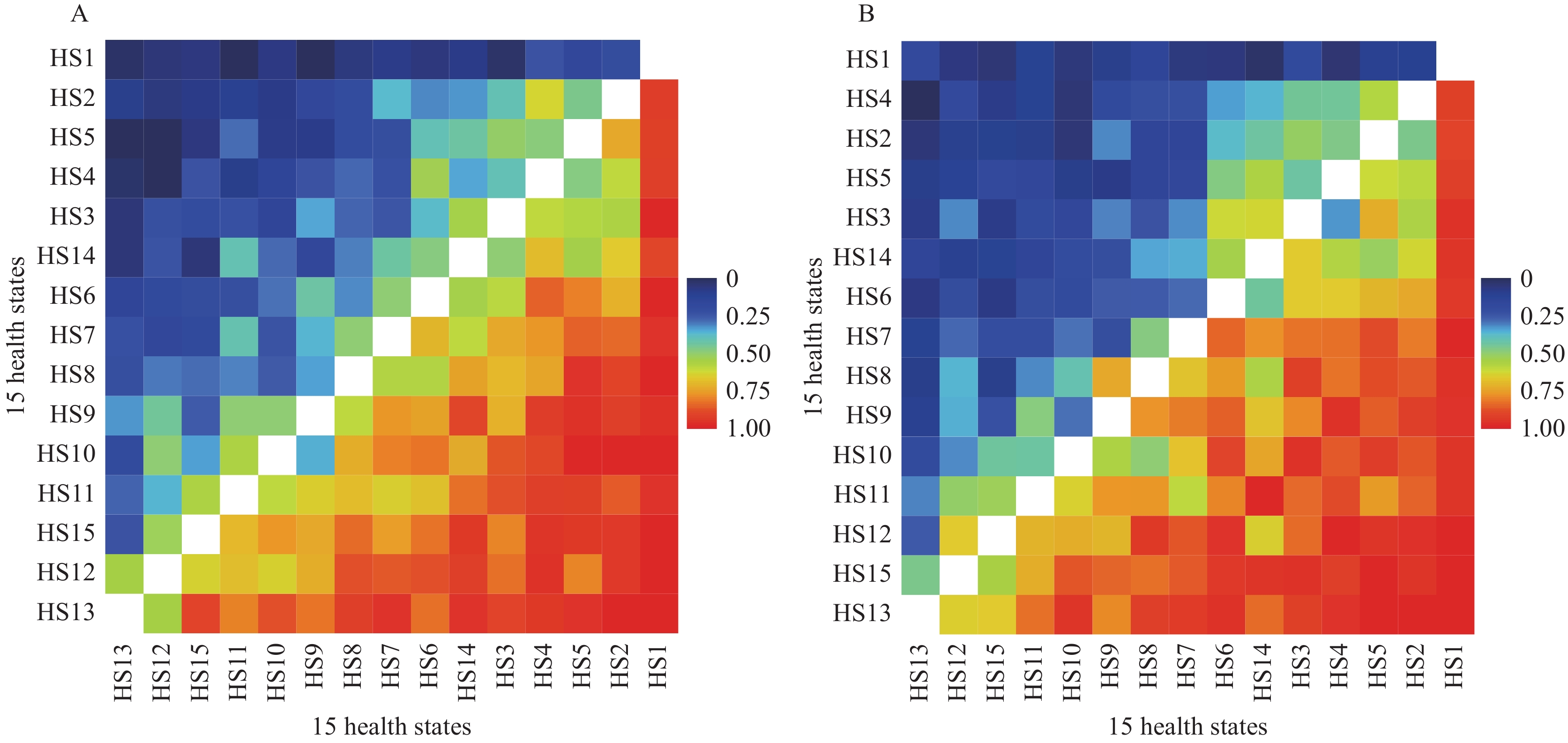 Figure 1.
Response probabilities for pairwise comparisons of health states. (A) General population; (B) Medical professionals.
Note: Each cell shows the response probability for one pair of states. The colors correspond to the probability that the first health state in pairwise comparison was chosen as the healthier outcome. HS1–HS15 represent the following health states: mild vision disorder, chronic low back pain, breast cancer (disease-free stage without permanent sequelae), deafness, diabetes mellitus, mild dementia, severe asthma, coronary heart disease (stage at diagnosis and primary therapy), stroke moderate impairments (acute incident plus rehabilitation phase), colorectal cancer, HIV/AIDS (seropositive, asymptomatic), severe depression, quadriplegia, mild chronic cadmium poisoning, and severe chronic cadmium poisoning.
Abbreviation: HS=health state; HIV/AIDS=human immunodeficiency virus/acquired immunodeficiency syndrome.
-
Estimated DWs for chronic cadmium poisoning are presented in Table 2. Based on the fitting curve of the Loess model (
Supplementary Figure S1 ), DWs of mild and severe chronic cadmium poisoning for the general population were 0.099 (95% UI: 0.051, 0.184) and 0.363 (95% UI: 0.196, 0.572), respectively. For medical professionals, DWs of mild and severe chronic cadmium poisoning were 0.102 (95% UI: 0.052, 0.189) and 0.397 (95% UI: 0.215–0.611), respectively. The overlapping areas of the 95% UIs were large for DWs for both mild and severe chronic cadmium poisoning in the two populations. DWs for severe chronic cadmium poisoning were significantly higher than those for mild chronic cadmium poisoning and ranked between colorectal cancer and severe depression.Health state General population Medical professionals GBD 2023 study Chinese national study Rank1 Coef* DWs (95% UI) Rank2 Coef* DWs (95% UI) Rank3 DWs (95% UI) Rank4 DWs (95% UI) Mild vision disorder 1 2.308 0.012 (0.002−0.068) 1 2.500 0.012 (0.002−0.066) 1 0.011 (0.005−0.020) 1 0.016 (0.001−0.081) Chronic low back pain 2 0.671 0.095 (0.044−0.194) 3 0.709 0.096 (0.044−0.194) 10 0.325 (0.219−0.446) 8 0.180 (0.089−0.311) Breast cancer (disease-free stage without permanent sequelae) 4 0.405 0.100 (0.051−0.186) 6 0.494 0.107 (0.054−0.200) 2 0.049 (0.031−0.072) 2 0.045 (0.006−0.153) Deafness 5 0.621 0.102 (0.048−0.205) 5 0.621 0.106 (0.051−0.208) 7 0.215 (0.144−0.307) 6 0.151 (0.065−0.287) Diabetes mellitus 6 0.600 0.104 (0.049−0.206) 7 0.498 0.108 (0.054−0.202) 2 0.049 (0.031−0.072) 2 0.045 (0.006−0.153) Mild dementia 7 0.174 0.112 (0.058−0.206) 2 0.338 0.094 (0.048−0.175) 4 0.069 (0.046−0.099) 4 0.047 (0.007−0.157) Severe asthma 8 −0.050 0.152 (0.076−0.281) 8 −0.140 0.154 (0.075−0.293) 5 0.133 (0.086−0.192) 9 0.227 (0.136−0.346) Coronary heart disease (stage at diagnosis and primary therapy) 9 −0.154 0.170 (0.084−0.316) 9 −0.280 0.177 (0.084−0.334) 6 0.167 (0.110−0.240) 7 0.163 (0.074−0.297) Stroke moderate impairments (acute incident plus rehabilitation phase) 10 −0.487 0.244 (0.123−0.426) 10 −0.512 0.224 (0.109−0.404) 9 0.316 (0.206−0.437) 5 0.111 (0.036−0.247) Colorectal cancer 11 −0.530 0.256 (0.131−0.440) 11 −0.659 0.262 (0.134−0.449) 8 0.288 (0.193−0.399) 11 0.264 (0.176−0.371) HIV/AIDS (seropositive, asymptomatic) 12 −0.550 0.261 (0.134−0.446) 12 −0.788 0.300 (0.159−0.492) – – – – Severe depression 14 −0.921 0.389 (0.208−0.607) 14 −1.122 0.422 (0.225−0.648) 12 0.658 (0.477−0.807) 12 0.699 (0.608−0.777) Quadriplegia 15 −1.358 0.575 (0.210−0.873) 15 −1.491 0.581 (0.228−0.867) 11 0.402 (0.268−0.545) 10 0.262 (0.174−0.370) Mild chronic cadmium poisoning 3 0.283 0.099 (0.051−0.184) 4 0.205 0.102 (0.052−0.189) – – – – Severe chronic cadmium poisoning 13 −0.856 0.363 (0.196−0.572) 13 −1.058 0.397 (0.215−0.611) – – – – Note: “–”: incomparability.
Abbreviation: DW=disability weight; UI=uncertainty interval; GBD=global burden of disease; HIV/AIDS=human immunodeficiency virus/acquired immunodeficiency syndrome; coef=coefficient.
* The probability regression coefficients.Table 2. Estimated disability weights and 95% uncertainty intervals for each health state — general population, medical professionals, and reference studies (the GBD 2023 and a Chinese national study), Shenyang City, Liaoning Province, China, June–August 2022.
-
Estimated DWs (95% UI) of the general population and medical professionals are presented in Table 2. The DWs of the 13 health states were similar between the two populations, especially in the last 7 health states. Among the 13 health states between the two populations, 10 had differences in DWs of less than 0.010, with the largest difference for HIV/AIDS (seropositive, asymptomatic) (0.039). In this study, mild vision disorder had the lowest DWs for the general population and medical professionals [0.012 (95% UI: 0.002, 0.068) and 0.012 (95% UI: 0.002, 0.066), respectively], whereas quadriplegia had the highest [0.575 (95% UI: 0.210, 0.873) and 0.581 (95% UI: 0.228, 0.867), respectively].
-
In comparison to the GBD 2023 study (4), DWs for 5 of the 12 health states of the general population and 6 of the 12 health states of medical professionals were within the 95% UIs of the GBD 2023 study. DWs of chronic low back pain, deafness, and severe depression were below the lower limit of the corresponding 95% UIs of the GBD 2023 study, with absolute differences of 0.113 to 0.269 and 0.109 to 0.236 for the two populations, respectively. DWs of breast cancer (disease-free stage without permanent sequelae), diabetes mellitus, and quadriplegia were above the upper limit of the corresponding 95% UIs of the GBD 2023 study, with absolute differences of 0.051 to 0.173 and 0.058 to 0.179, respectively. In addition, DWs of mild dementia was also above the level of the GBD 2023 with an absolute difference of 0.043 for the general population.
Compared with the Chinese national study (11), DWs for 10 of the 12 health states were within the corresponding 95% UIs of the Chinese national study for the two populations. DW values of severe depression were well below the lower limit of the corresponding 95% UI of the Chinese national study, with absolute differences of 0.310 and 0.277, respectively, and DWs values of quadriplegia were above the upper limit of the 95% UI of the Chinese national study, with an absolute difference of 0.310 for both the general population and medical professionals.
-
Correlations between the DWs drawn from the two populations in the present study, the GBD 2023 study (4), and the Chinese national study (11) are shown in Table 3. Spearman's rank correlation coefficient for DWs between the general population and medical professionals was 0.95 (P<0.001). Their correlations for DWs between the general population and the GBD 2023 study and between medical professionals and the GBD 2023 study were 0.64 (P<0.05) and 0.67 (P<0.05), respectively. In contrast, their correlations with the Chinese national study were 0.72 (P<0.001) and 0.73 (P<0.001), respectively.
Study populations General population Medical professionals GBD 2023 study Chinese national study General population 1 Medical professionals 0.95** 1 GBD 2023 study 0.64* 0.67* 1 Chinese national study 0.72** 0.73** 0.83** 1 Abbreviation: GBD=global burden of disease.
* P<0.05; ** P<0.001.Table 3. Correlation analysis of disability weights between survey respondents (general population and medical professionals), the GBD 2023 study, and a Chinese national study; Shenyang City, Liaoning Province, China, June–August 2022.
Participant Characteristics
Response Probabilities
Disability Weights
Severity Spectrum Disability Weights
Comparisons with Other Studies
Correlation Analysis
-
To our knowledge, this study is the first to derive DW parameters for chronic cadmium poisoning. Test-retest reliability (0.80 and 0.79) exceeded European estimates (0.72 to 0.78) (12). Heatmaps indicated low measurement error and high consistency. These findings demonstrate the relatively high credibility of this study.
DWs for mild and severe poisoning were 0.099 and 0.363 in the general population, and 0.102 and 0.397 in medical professionals, respectively. In the two populations, the DWs of mild chronic cadmium poisoning ranked between chronic low back pain and breast cancer, whereas those of severe chronic cadmium poisoning ranked between colorectal cancer and severe depression. Previous studies used only kidney impairment DWs (0.091) to calculate DALYs due to the lack of available DWs, underestimating health damage (13–14). Bone damage of severe poisoning exceeded moderate musculoskeletal problems (moderate generalized) in the GBD 2023 study (4) but were lower than severe musculoskeletal problems. Existing DWs inadequately reflect chronic cadmium poisoning, highlighting the need for condition-specific DWs.
Comparisons of DW severity spectrum with those of other studies revealed interesting findings. Of the DWs of the 12 health states in this study, only 5 were within the corresponding 95% UIs of the GBD 2023 study (4), while 10 were within the corresponding 95% UIs of the Chinese national study (11). Moreover, their correlations with the GBD 2023 study were smaller than those with the Chinese national study. With regard to deafness, an indicator of the reliability of the results (8), the variation intensity to the Chinese national study is lower than that to the GBD 2023 study, suggesting that the present study was localized and representative of the Chinese population. As suggested by Nomura et al. (15), there may be contextual differences in rating the severity of health states across countries with different cultures and income levels, and country-specific DWs should be applied in future studies.
Piao et al. (5) found that DWs were higher for medical professionals than the general population. In contrast, the present study found no significant difference in DWs between the two populations, inversely confirming the health state descriptions of the EQ-5D+C-3L (6) and representativeness of the general population in the GBD study.
The findings in this report are subject to at least two limitations. First, the survey was conducted only in Shenyang, limiting the generalizability of these findings. A national survey covering all regions should be conducted to enhance the representativeness of DW values. Second, the web-based survey method introduced a sample bias toward younger and more educated participants. However, this limitation led to enhanced response quality due to the participants' stronger comprehension.
In conclusion, this study derived DWs for mild and severe chronic cadmium poisoning based on the PC method. There were no significant differences in DWs between the general population and medical professionals, providing a basis for measuring health damage due to environmental risks.
-
Approved by the ethics committee of the China Medical University (Shenyang City, Liaoning Province, China).
| Citation: |

|