


 Download:




-
Introduction: This study examined the associations among occupational noise exposure, hearing-related functional difficulty, and menstrual abnormalities in female workers, and explored the potential role of noise annoyance.
Methods: In this cross-sectional survey, 3,283 female workers were screened, and 1,538 were included in the final analysis. Multivariate logistic regression and exploratory mediation analyses were conducted with bootstrap resampling.
Results: The prevalence rates of menstrual abnormalities and hearing-related functional difficulties were 22.82% and 17.88%, respectively. High occupational noise exposure was associated with higher odds of hearing-related functional difficulty [adjusted odds ratio (aOR)=1.79, 95% confidence interval (CI): 1.30–2.46] and menstrual abnormalities (aOR=2.70, 95% CI: 1.96–3.73). Sensitivity analyses for menstrual abnormalities yielded consistent results. In the exploratory mediation analyses, the indirect effect estimates were modest for hearing-related outcomes and not statistically significant for menstrual abnormalities.
Conclusion: High occupational noise exposure is associated with higher odds of hearing-related functional difficulties and menstrual abnormalities in female workers. Noise annoyance may represent a potential explanatory pathway for hearing-related outcomes; however, the mediation findings should be interpreted cautiously.
-
Occupational noise is a pervasive hazard in modern industries, and its adverse effects extend beyond the auditory system (1). As an environmental stressor, noise can disrupt endocrine equilibrium. Emerging evidence suggests that chronic noise exposure is associated with menstrual abnormalities. However, the mechanisms linking physical exposure to reproductive outcomes remain unclear.
Noise annoyance has been proposed as a psychophysiological stress-related response that may explain how noise exposure affects health. This rationale is supported by a systematic review and meta-analysis showing that high noise annoyance is associated with poorer mental health outcomes. A recent systematic review suggests that noise annoyance is among the most plausible mediating pathways linking noise exposure to adverse health effects (2–3). Recent reviews have indicated that noise-related stress may affect mental and physiological health through broader stress and neuroendocrine pathways (4). This cross-sectional study examined occupational noise exposure, hearing-related functional difficulties, and menstrual abnormalities in female workers. By evaluating whether noise-related disturbances represent a potential explanatory pathway for these associations, this study aims to provide evidence for more comprehensive occupational health interventions that address both physical hazards and work-related stress responses.
This cross-sectional survey was conducted in 2024-2025 across enterprises in the food, machinery, and mining sectors in four provincial-level administrative divisions (PLADs) of China (Gansu, Beijing, Hebei, and Chongqing). Study sites and industries were selected to capture regional variations, reflect industry-specific noise exposure patterns, and ensure feasibility in field implementation. Participants were recruited from representative enterprises in each study region. A total of 3,283 female workers were screened, and 1,538 were included in the final analysis after applying the prespecified exclusion criteria and removing records with incomplete information; the recruitment and exclusion process is shown in
Supplementary Figure S1 . The study protocol was approved by the Ethics Committee of the National Institute of Occupational Health and Poison Control, Chinese Center for Disease Control and Prevention (NIOHP202324). All the participants provided written informed consent. The inclusion criteria were: 1) age between 20 and 50 years, and 2) at least one year of employment at the factory, with at least six months in the current position. The exclusion criteria were as follows: 1) pregnant or breastfeeding women; 2) use of hormone medications or ototoxic drugs in the past 3–6 months; and 3) diagnosis of organic reproductive system diseases, ear disorders, or a history of surgery.Individual occupational noise exposure was quantified as the 8-h normalized A-weighted equivalent continuous sound level [LEX,8h, dB(A)] for each participant. Noise was measured using a personal noise dosimeter (ASV5910-R, Hangzhou Aihua Instruments Co., Ltd.) according to GBZ/T 189.8–2007 (Measurement of Physical Agents in Workplace — Part 8: noise). Each participant was measured thrice during routine shifts, and the dosimeter was calibrated before and after each measurement using a sound-level calibrator.
A structured questionnaire was used to collect data on: 1) General information, including age, education, marital status, smoking, alcohol consumption, work duration, shift work, hearing protection use, age at menarche, and parity history. Shift work was classified according to the self-reported work schedule into normal shift, day-shift rotation, and night-shift rotation. When both day- and night-shift rotations were reported, the participants were classified as having night-shift rotations. Parity history refers to whether the participant had a previous childbirth history (yes/no). 2) Hearing-related functional difficulty was assessed using the Hearing Handicap Inventory for Adults (HHIA) (5). Each participant rated the frequency of hearing difficulties, and responses were summed to yield a total score, with higher scores indicating greater functional impairment. An HHIA >8 indicated hearing-related functional difficulty. 3) Menstrual abnormalities were evaluated using self-reporting based on clinical criteria (6), including cycle irregularities (<21 or >35 days), abnormal flow (excessive or <5 mL), and duration (<2 or >8 days). Any abnormality was classified as a menstrual abnormality. 4) Noise annoyance was assessed using a five-point scale specified in the Chinese national standard GB/Z 21233–2007 (Acoustics — Assessment of noise annoyance in social and socio-acoustic surveys). The response options ranged from "not at all" to "very severe" (7).
Data were double-entered into Microsoft Excel and analyzed using Python (version 3.13.5, Python Software Foundation, Fredericksburg, VA, US) with pandas, numpy, and statsmodels. Baseline characteristics across noise exposure groups were compared using Welch's t-test or the Mann–Whitney U test for continuous variables and the chi-squared test or Fisher's exact test for categorical variables, as appropriate. Multivariable logistic regression was used to estimate the odds ratios (ORs) and 95% confidence intervals (CIs). The hearing-related model was adjusted for age, education, marital status, work duration, shift work, body mass index, smoking, alcohol consumption, hearing protection use, hypertension, diabetes, hyperlipidemia, and study site. The menstrual abnormality model adjusted for age, education, marital status, work duration, shift work, body mass index, smoking, alcohol consumption, hypertension, diabetes, hyperlipidemia, age at menarche, parity history, perimenopausal status, and study site. Mediation analysis was conducted using a regression-based approach with 5,000 bootstrap re-samples. In this framework, the total effect represents the overall association between occupational noise exposure and the outcome, the direct effect reflects the association after accounting for noise annoyance, and the indirect effect represents the portion operating through noise annoyance. The proportion of mediation was calculated as the indirect effect divided by the total effect.
Among the 1,538 female workers in the final analysis, the mean age was 39.35 (6.34) years. The prevalence rates of menstrual abnormalities and hearing-related functional difficulties were 22.82% and 17.88%, respectively. The baseline characteristics stratified by noise exposure group are shown in Table 1; both outcomes were more common in the high-noise group (Figure 1). After adjustment for potential confounders, high occupational noise exposure was significantly associated with hearing-related functional difficulty (aOR=1.79, 95% CI: 1.30–2.46) and menstrual abnormalities (aOR=2.70, 95% CI: 1.96–3.73) (Figure 2). Sensitivity analyses redefining perimenopausal status using a cutoff of ≥40 years, as well as subgroup analyses restricted to women aged <45 years, yielded generally consistent results for menstrual abnormalities (perim40: OR=2.70, 95% CI: 1.96–3.72; age <45 years: OR=3.32, 95% CI: 2.25–4.91). In the mediation analyses, the indirect effect estimates were modest for hearing-related outcomes and were not statistically significant for menstrual abnormalities (
Supplementary Figure S2 ).Variable <85 dB(A) (n=921) n (%) ≥85 dB(A) (n=617) n (%) P Age (years) 39.27 (6.50) 39.47 (6.10) 0.537 BMI (kg/m2) 23.03 (3.11) 22.89 (3.06) 0.389 Menarche age (year) 14.17 (1.56) 14.06 (1.63) 0.219 Exposure duration (year) 4 (2,9) 7 (3,12) <0.001 LEX,8h [dB(A)] 78.16 (5.61) 86.59 (2.24) <0.001 Study site Beijing 66 (7.17) 15 (2.43) <0.001 Hebei 487 (52.88) 196 (31.77) Chongqing 249 (27.04) 59 (9.56) Gansu 119 (12.92) 347 (56.24) Smoking status Non-smoking 917 (99.57) 614 (99.51) 1.000 Smoking 4 (0.43) 3 (0.49) Alcohol consumption Occasional/none 895 (97.18) 603 (97.73) 0.613 Regular drinking 26 (2.82) 14 (2.27) Annoyance Not at all 214 (23.24) 67 (10.86) <0.001 Slight 337 (36.59) 225 (36.47) Moderate 336 (36.48) 228 (36.95) Severe 22 (2.39) 74 (11.99) Very severe 12 (1.30) 23 (3.73) Shift work Normal shift 481 (52.23) 259 (41.98) <0.001 Day-shift rotation 82 (8.90) 80 (12.97) Night-shift rotation 358 (38.87) 278 (45.06) Parity history Yes 794 (86.21) 550 (89.14) 0.106 No 127 (13.79) 67 (10.86) Menstrual abnormality Normal 774 (84.04) 413 (66.94) <0.001 Abnormal 147 (15.96) 204 (33.06) Hearing-related functional difficulty Normal 809 (87.84) 454 (73.58) <0.001 Abnormal 112 (12.16) 163 (26.42) Note: Continuous variables are presented as mean (SD) or median (interquartile range), as appropriate. Categorical variables are presented as n (%). P values were calculated using Welch’s t-test, Mann–Whitney U test, chi-squared test, or Fisher’s exact test, as appropriate. The noise exposure groups were defined according to the individual 8-hour equivalent continuous A-weighted sound pressure level [LEX,8h], with <85 dB(A) as the low-noise group and ≥85 dB(A) as the high-noise group. Shift work was classified as normal shift, day-shift rotation, and night-shift rotation according to the self-reported work schedule. Parity history refers to whether the participant had a childbirth history (yes/no).
Abbreviation: BMI=body mass index; LEX,8h=8-hour normalized A-weighted equivalent continuous sound level; SD=standard deviation.Table 1. Baseline characteristics of participants stratified by noise exposure group.
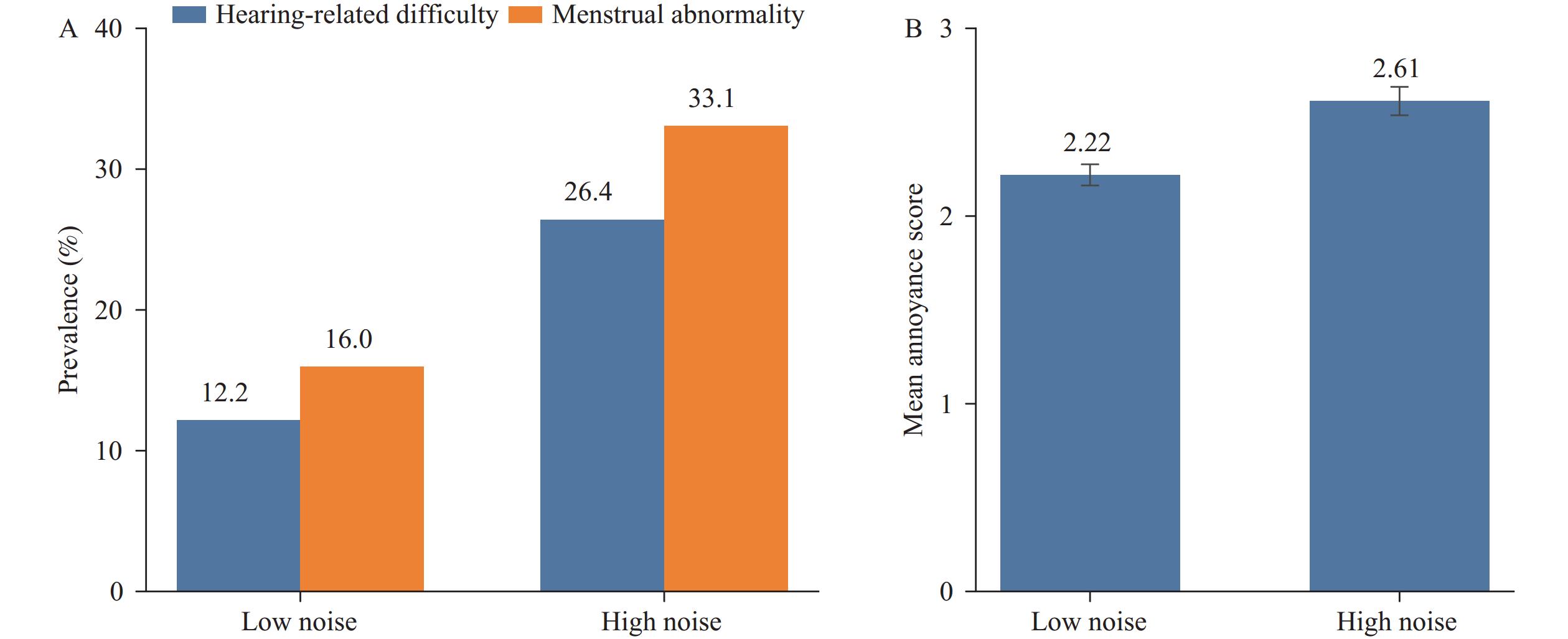 Figure 1.
Crude prevalence of hearing-related functional difficulty and menstrual abnormalities and mean annoyance score by the low-noise [LEX,8h<85 dB(A)] and high-noise [LEX,8h≥85 dB(A)] groups. (A) unadjusted prevalence of hearing-related functional difficulty and menstrual abnormalities. (B) mean annoyance score with 95% confidence intervals.
Note: LEX,8h=8-hour normalized A-weighted equivalent continuous sound level.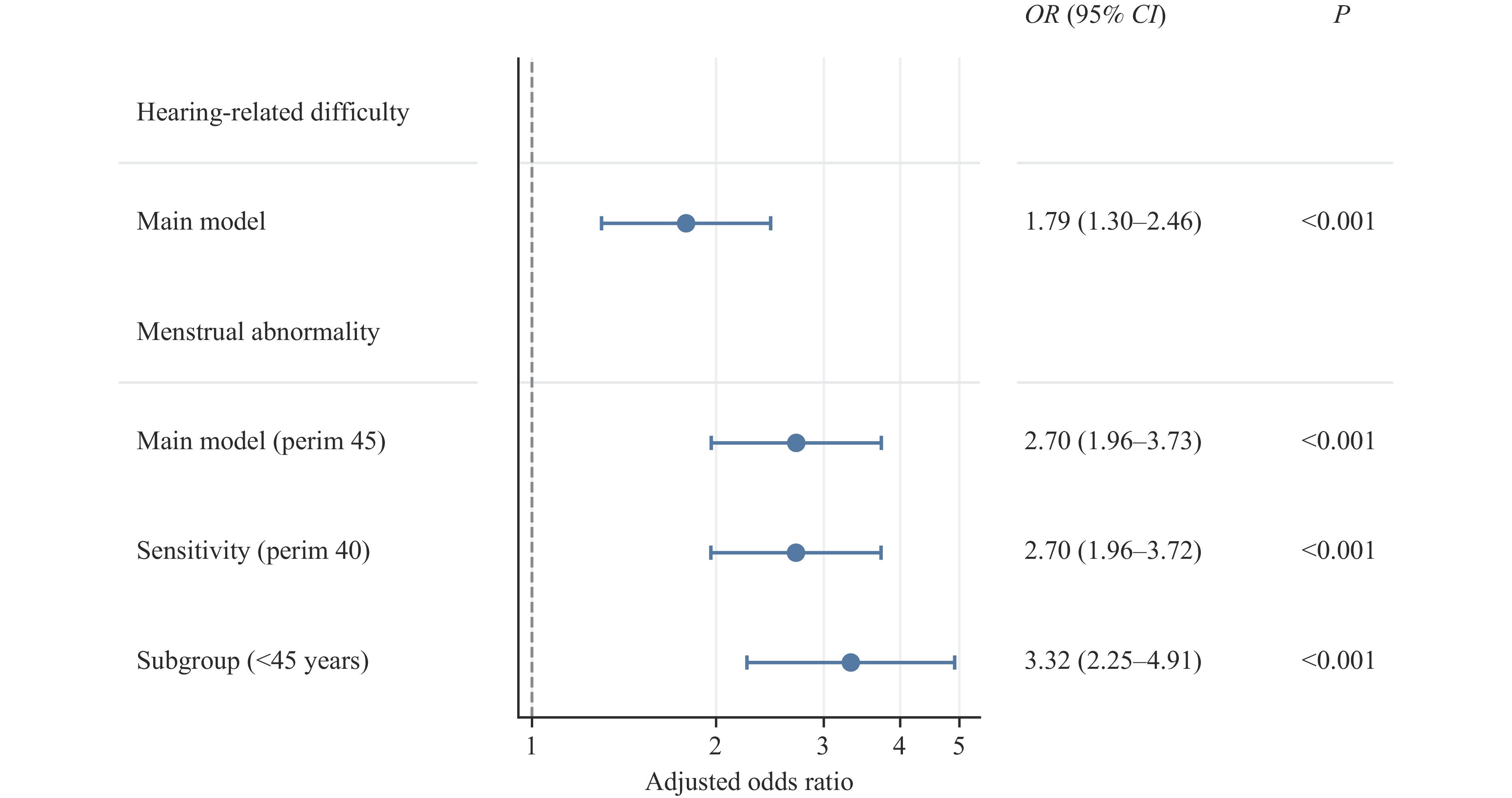 Figure 2.
Adjusted associations of high occupational noise exposure with hearing-related functional difficulty and menstrual abnormalities.
Note: Points indicate odds ratios and horizontal lines indicate 95% CIs. Results are shown for the main adjusted models and menstrual sensitivity/subgroup analyses.
Abbreviation: OR=odds ratio; CI=confidence interval.
-
This study found that high occupational noise exposure is associated with increased odds of hearing-related functional difficulties and menstrual abnormalities among female workers. This association with hearing-related outcomes is consistent with previous evidence suggesting adverse auditory effects of occupational noise exposure (8). The indirect effect estimates for noise annoyance in the hearing-related model were modest, suggesting that psychophysiological stress responses may represent a potential explanatory pathway, in addition to direct auditory injury. The first mechanism is the well-established direct mechanical injury to cochlear hair cells. The second mechanism may be an indirect psychophysiological pathway in which chronic annoyance activates the HPA axis (9). Triggering the stress response (e.g., altered blood flow and oxidative stress) can amplify cochlear damage. Because this was a cross-sectional study, the findings should not be interpreted as evidence of a confirmed causal mediation pathway. We also observed a significant association between high noise exposure and menstrual abnormalities. Menstrual function depends on coordinated neuroendocrine regulation, and chronic stress related to noise exposure may contribute to menstrual disturbance (10). However, no statistically significant indirect effect of noise annoyance on menstrual abnormalities was observed, suggesting that other mechanisms may be involved.
This study had several limitations. First, due to its cross-sectional design, the temporal sequence and causal pathways could not be established, and the mediation findings should be interpreted cautiously. Second, the HHIA reflects self-reported hearing-related difficulty rather than objective audiometric hearing loss. Therefore, the findings should not be interpreted as evidence of clinically confirmed or noise-induced hearing loss. Third, menstrual abnormalities were defined using broad self-reported composite outcomes. Additionally, the observed prevalence may have been influenced by study sites, industries, and sampling proportions. Because only participants meeting the eligibility criteria with complete information were included in the final analysis, selection bias could not be excluded. Residual confounding factors and reporting biases were not excluded.
Overall, occupational noise exposure is associated with hearing-related functional difficulties and menstrual abnormalities. Noise annoyance may represent a potential explanatory pathway for hearing-related outcomes; however, the mediation findings should be interpreted cautiously. Longitudinal studies are required to elucidate these underlying mechanisms.
HTML
| Citation: |

|