


 Download:




-
Introduction: The increasing availability of diverse tobacco products has led to increased tobacco use. This study analyzed prevalence and associated factors of different tobacco-use statuses among Chinese adolescents to support effective interventions for cigarette and e-cigarette use among adolescents in China.
Methods: A two-stage survey was conducted with a weighted sample of 15,000 high-school students from 31 provincial-level administrative divisions in mainland China. The prevalence of different tobacco-use statuses was also analyzed. Individual, school, family, and marketing exposure factors associated with different statuses were analyzed using multinomial logistic regression.
Results: Prevalences among Chinese high-school students were 6.9% [95% confidence interval (CI): 6.5, 7.3] for dual use, 27.2% (95% CI: 25.0, 29.5) for overall tobacco, 9.5% (95% CI: 9.1, 10.1) for e-cigarettes, and 24.6% (95% CI: 23.9, 25.3) for cigarettes. Socioecological factors were heterogenous across statuses. Some factors expected to reduce tobacco use were not associated with decreased use and were even associated with increased use.
Conclusion: It is important to focus on the shared and distinct factors influencing dual and exclusive cigarette/e-cigarette use to develop intervention measures. Integrating family involvement, peer-based approaches, and evidence-based school education into tobacco control programs may enhance the effectiveness of smoking prevention in adolescents.
-
Recently, tobacco products used by adolescents have become increasingly diverse (1). The 2021 China National Youth Tobacco Survey found 16.7% of middle school students had ever used cigarettes, and 16.1% had ever used e-cigarettes (2). However, most previous studies have focused on either cigarette or e-cigarette use alone; evidence on dual and exclusive use statuses among Chinese adolescents remains limited. To develop effective strategies for preventing different statuses of adolescent use, it is essential to comprehensively understand associated factors.
An online survey of 16,365 high-school students in 31 provincial-level administrative divisions (PLADs) in China comprehensively collected information on tobacco-use status, individual characteristics, family and school environments, and e-cigarette marketing. This study analyzed the prevalence and associated socio-ecological factors of different tobacco-use statuses in this population. The findings are intended to inform effective interventions for controlling dual cigarette and e-cigarette use (dual use) and exclusive cigarette/e-cigarette use among adolescents in China and other countries with similar cultural and policy contexts.
A two-stage online survey was conducted among high-school students from July to September 2021 using the sample size calculator developed by Wang et al. (3) to estimate the minimum required sample size. Based on the results of an online pilot survey of 104 conveniently sampled high-school students, the study set the proportion of current e-cigarette users among high-school students (p) to 8.7% with a Type I error rate (α) of 0.05 and absolute error (d) of 0.5%. The minimum sample size was thus estimated to be 12,206. To simplify sample size allocation, we increased the overall sample size goal to 15,000.
The first stage covered all 31 PLADs in China. The overall sample size goal was allocated to each PLAD based on the proportion of high-school students relative to the national total according to official statistics. The second stage employed stratified sampling based on sex, residence, and school type within each PLAD to obtain representative samples. The study allocated sample size goals to each stratum based on the proportion of high-school students in each stratum relative to the total number in the corresponding PLAD. To minimize sampling errors, strata with sample size goals below 30 were oversampled to ensure at least 30 students were surveyed per stratum.
Participants were recruited through the registered member network of KuRunData. The target group was identified using basic personal information. Randomly selected potential respondents received SMS messages and email invitations with unique survey links. Eligibility was verified through registered personal information, including school affiliation, date of birth, and IP-based location checks, and periodic authenticity tests by the platform. Initially, 21,085 students accessed the survey; 1,652 were excluded for incomplete responses and 3,068 for quality issues. These exclusions were due to substandard response quality, including logically abnormal or repetitive answers, completion in under five minutes, or because sample size targets for specific strata had been met. The final sample size was 16,365. The overall response rate was 77.6% (16,365/21,085).
Because the sample exceeded the predetermined goal of 15,000, respondents received sample weights to ensure alignment of the sample composition with official PLAD statistics on gender, residence, and school type. These weights were calculated by dividing the sample size goal by the number of respondents in each stratum. All analyses were performed on weighted samples unless otherwise stated.
Tobacco-use status was the outcome variable in the analysis and was classified into four use categories: dual, exclusive cigarette, exclusive e-cigarette, and no use. Use was determined based on self-reported frequency of cigarette/e-cigarette use in the last 30 days; one or more days of use were considered use. Dual use was defined as concurrent use of cigarettes and e-cigarettes. Thirty-seven potentially associated factors were examined as exposure variables, categorized into four groups: 5 individual characteristics, 11 family factors, 9 school factors, and 2 marketing exposure factors.
A multinomial logistic regression model incorporating all factors, adjusting for PLAD fixed effects, was fitted to identify associations between independent factors and tobacco-use status. To account for the survey’s multistage sampling process, complex survey data analyses were performed for all statistical inferences of standard errors, 95% confidence intervals (CIs), and statistical significance, with standard errors clustered at the primary sampling unit level. Two-sided P<0.05 indicated statistical significance. All data analyses were conducted using Stata (version 17.0; StataCorp LLC, College Station, Texas, USA). Bivariate choropleth maps and forest plots were generated using R (version 4.3.0; R Foundation for Statistical Computing, Vienna, Austria).
The weighted sample consisted of 15,000 students, with approximately equal proportions of male (49.9%) and female (50.1%) participants and a median age of 17 (interquartile range: 16–18) years. Most students resided in urban areas (59.5%), attended general high schools (66.5%), and were in 12th grade (48.8%) (Table 1).
Characteristic Full sample
(nweighted=15,000)Dual use
(nweighted=1,029)Exclusive cigarette use
(nweighted=2,655)Exclusive e-cigarette
use (nweighted=398)Nonuse of both
(nweighted=10,918)Male, n (%) 7,483 (49.9) 874 (84.9) 2,351 (88.5) 287 (72.0) 3,971 (36.4) Age (years), median (IQR) 17 (16, 18) 18 (17, 18) 17 (17, 18) 17 (16, 18) 17 (16, 18) Age group (years), n (%) ≤16 2,004 (13.4) 60 (5.8) 224 (8.4) 48 (12.1) 1,672 (15.3) >16–17 5,374 (35.8) 207 (20.1) 629 (23.7) 109 (27.4) 2,765 (25.3) >17–18 3,914 (26.1) 365 (35.4) 1,163 (43.8) 136 (34.1) 3,711 (34.0) >18 3,914 (26.1) 398 (38.6) 639 (24.1) 105 (26.5) 2,771 (25.4) Urban residence, n (%) 8,924 (59.5) 697 (67.7) 1,866 (70.3) 201 (50.5) 6,160 (56.4) School type, n (%) General high schools 9,977 (66.5) 355 (34.5) 1,743 (65.6) 118 (29.6) 7,762 (71.1) Vocational high schools 5,022 (33.5) 674 (65.5) 912 (34.4) 280 (70.4) 3,156 (28.9) Grade, n (%) 10th 3,069 (20.5) 130 (12.6) 382 (14.4) 81 (20.5) 2,476 (22.7) 11th 4,605 (30.7) 273 (26.6) 936 (35.3) 135 (34.0) 3,260 (29.9) 12th 7,326 (48.8) 626 (60.8) 1,336 (50.3) 181 (45.5) 5,182 (47.5) Note: The presented results were derived from a weighted sample. n (%), frequency with percentage.
Abbreviation: IQR=interquartile range.Table 1. Sample characteristics by tobacco use status, weighted.
Dual-use prevalence was 6.9% (95% CI: 6.5, 7.3): 11.7% (95% CI: 11.0, 12.4) among male students, significantly higher than female students’ 2.1% (95% CI: 1.8, 2.4). Regionally, a higher dual-use prevalence was observed in the eastern [e.g., Shanghai: 11.7% (95% CI: 4.4, 27.8), Beijing: 11.1% (95% CI: 4.9, 23.4)] and western [e.g., Xinjiang: 9.6% (95% CI: 4.4, 19.1)] regions (Figure 1). Prevalences of overall tobacco use, cigarette use (including dual and exclusive cigarette), and e-cigarette use (including dual and exclusive e-cigarette) were 27.2% (95% CI: 25.0, 29.5), 24.6% (95% CI: 23.9, 25.3), and 9.5% (95% CI: 9.1, 10.1), respectively (Figure 1).
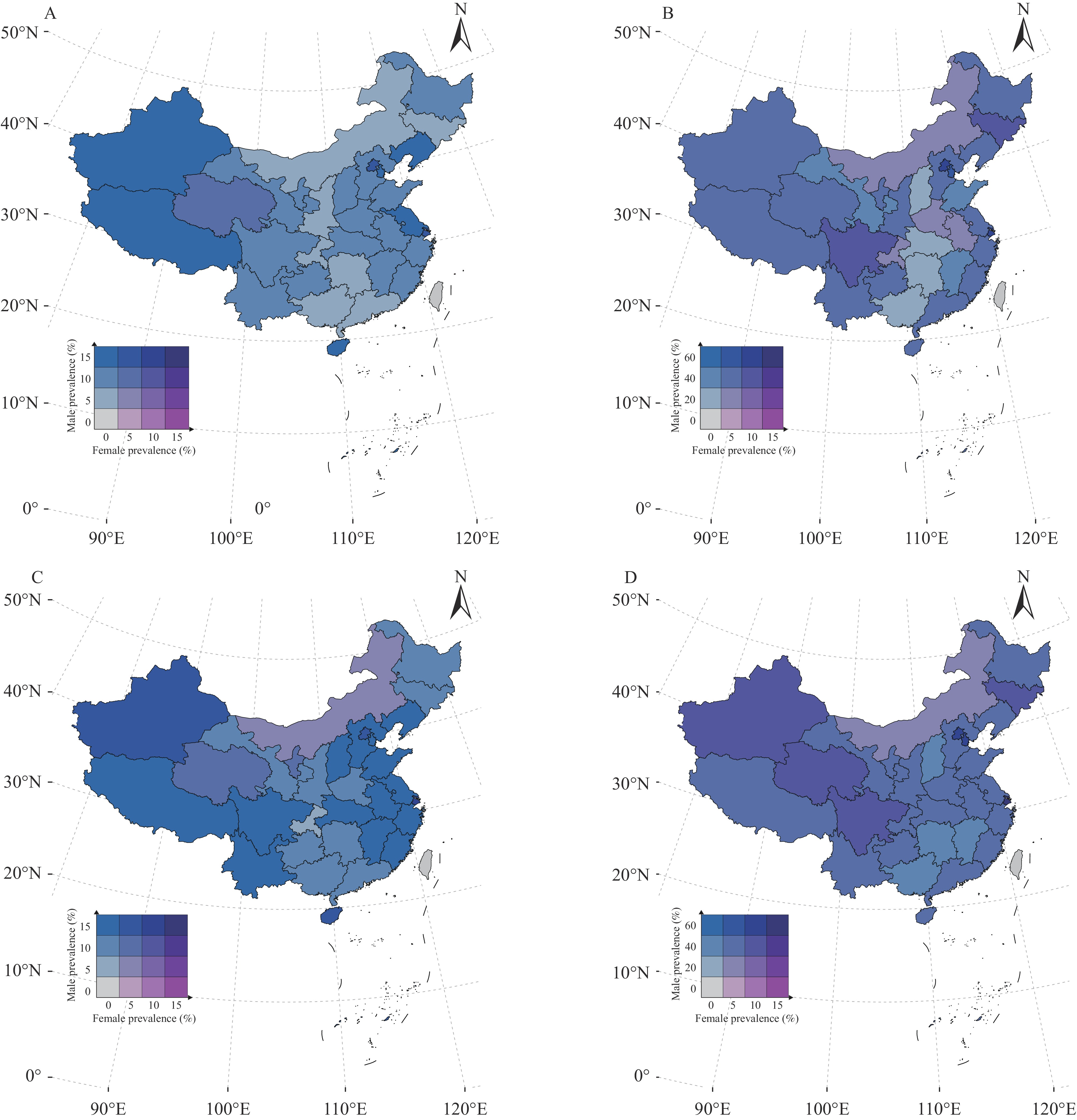 Figure 1.
Weighted prevalence of different tobacco use statuses among high school students in China. (A) The prevalence of dual cigarette and e-cigarette use. (B) The prevalence of cigarette use. (C) The prevalence of e-cigarette use. (D) The prevalence of overall tobacco use includes either cigarette use or e-cigarette use.
Note: The presented results were derived from a weighted sample of school students from all 31 provincial-level administrative divisions in China.
Map approval number: GS京(2026)0451号.
Some factors showed consistent associations across different tobacco-use statuses; others exhibited varying effects depending on tobacco-use type. Among socio-ecological factors, consistent associations were found across use types for high parental educational attainment [secondary school vs. above secondary school: odds ratio (OR) dual use 0.70 (95% CI: 0.56, 0.87), exclusive cigarette use 0.75 (95% CI: 0.66, 0.85), exclusive e-cigarette use 0.73 (95% CI: 0.57, 0.92)], perceived favorable family economic status [poor vs. good: 0.22 (95% CI: 0.14, 0.34), 0.58 (95% CI: 0.46, 0.74), 0.35 (95% CI: 0.21, 0.57)], paternal e-cigarette use [current use: 4.04 (95% CI: 3.16, 5.16), 2.02 (95% CI: 1.6, 12.44), 3.77 (95% CI: 2.71, 5.24)], attending vocational high schools [3.63 (95% CI: 2.99, 4.42), 1.36 (95% CI: 1.21, 1.53), 4.62 (95% CI: 3.62, 5.90)], close friends using e-cigarettes [more than half using: 27.62 (95% CI: 17.05, 44.73), 2.00 (95% CI: 1.30, 3.08), 9.25 (95% CI: 5.10, 16.79); less than half using: 13.70 (95% CI:10.62, 17.66), 0.87 (95% CI: 0.73, 1.03), 6.15 (95% CI: 4.41, 8.59)], and free giveaways [1.99 (95% CI: 1.59, 2.50), 1.54 (95% CI: 1.27, 1.87), 1.84 (95% CI: 1.35, 2.50)].
Other factors demonstrated distinct or opposite patterns across tobacco-use statuses. Urban residence was positively associated with dual use and exclusive cigarette use [1.74 (95% CI: 1.43, 2.12), 1.89 (95% CI: 1.69, 2.12)] but negatively associated with exclusive e-cigarette use [0.75 (95% CI: 0.59, 0.96)]. Stricter family policies on cigarette/e-cigarette use were associated with decreased exclusive cigarette use [permitted in designated areas vs. prohibited completely: 1.34 (95% CI: 1.19, 1.51), permitted everywhere vs. prohibited completely: 1.43 (95% CI:1.19, 1.72)] but not associated with dual and exclusive e-cigarette use (Figure 2).
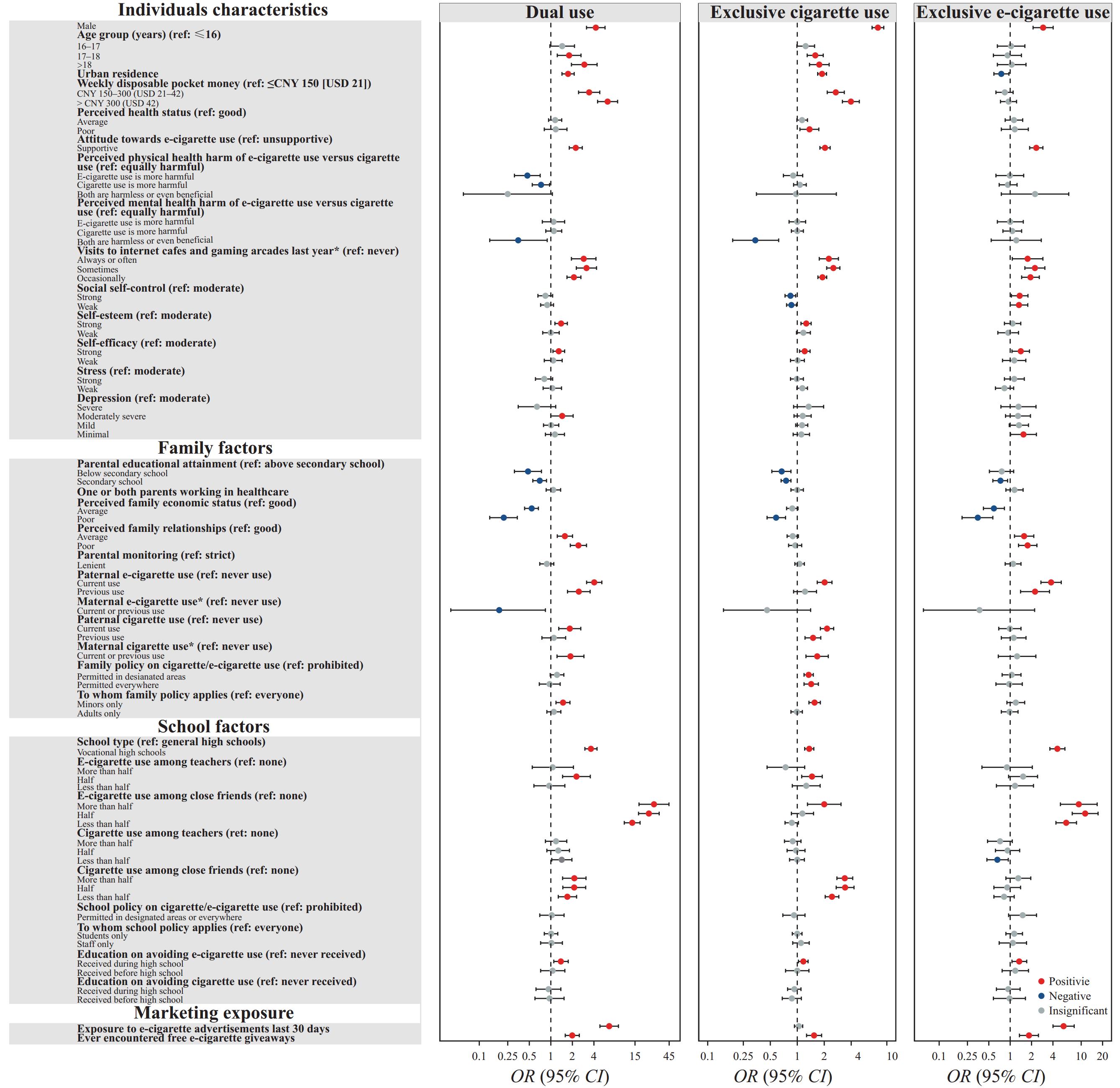 Figure 2.
Factors associated with tobacco use status among high school students in China, weighted.
Note: The presented results were derived from a weighted mutually adjusted multinomial logistic regression model with nonuse of cigarettes and e-cigarettes as the reference category. The model controlled for fixed effects of PLADs. Variance inflation factors for independent variables ranged from 1.1 to 2.4, indicating no significant multicollinearity. Effect sizes for associations are presented as ORs with 95% CIs.
Abbreviation: ref=reference; CNY=Chinese yuan; USD=United States dollar; OR=odds ratio; CI=confidence interval; PLAD=provincial-level administrative division.
*Some categories of these variables were combined due to insufficient sample sizes.
Certain factors expected to reduce tobacco use, such as education about avoiding cigarettes [received during high school: dual use 0.93 (95% CI: 0.62, 1.38), exclusive cigarette use 0.93 (95% CI: 0.78, 1.10), exclusive e-cigarette use 0.94 (95% CI: 0.64, 1.38); received before high school: 0.96 (95% CI: 0.60, 1.53), 0.87 (95% CI: 0.68, 1.11), 0.98 (95% CI: 0.58, 1.64)] and about avoiding e-cigarettes [received during high school: 1.38 (95% CI: 1.10, 1.25), 1.17 (95% CI: 1.03, 1.32), 1.34 (95% CI: 1.06, 1.71); received before high school: 1.06 (95% CI: 0.72, 1.57), 1.00 (95% CI: 0.74, 1.35), 1.18 (95% CI: 0.77, 1.81)], were not significantly associated with reduced tobacco use and may even be associated with increased use (Figure 2).
-
Among a representative sample of Chinese high-school students, the estimated prevalence of e-cigarette use was 9.5%, comparable to the reported prevalence among adolescents aged 12–16 years in 68 countries (9.2%) (4). Dual-use prevalence was 6.9%, higher than in the United Kingdom (6.5%) (5) and Canada (3.8%)(6). Similarly, cigarette-use prevalence (24.6%) was higher than among individuals aged 15–24 years in 204 countries (12.7%) (7). This highlights concerns about tobacco use among Chinese adolescents, warranting implementation of effective prevention measures.
Influencing factors differed between dual and exclusive cigarette/e-cigarette use. While stricter family policies were associated with reduced exclusive cigarette use, they were not associated with reduced exclusive e-cigarette use. This may be because parents often target cigarettes and less often recognize e-cigarettes as harmful. Moreover, e-cigarettes are relatively new and easier to conceal (8). Multichannel promotion and family-school collaboration are needed to raise awareness among adolescents and their guardians.
Additionally, urban residence was positively associated with dual and exclusive cigarette use, consistent with previous research (9). However, a negative association was observed with exclusive e-cigarette use. Notably, the upper CI bound for the urban residence-exclusive e-cigarette use association was close to non-significance, suggesting a marginal association. Further investigation using large-scale cohort studies is necessary to better understand this association and its underlying mechanisms.
Close friends’ use of these products had a stronger association than teachers’ use with adolescent tobacco use, likely because tobacco use can spread through social networks, and peer relationships, particularly with close friends, are more influential than student–teacher relationships (10). Therefore, interventions to curb tobacco use should leverage peer social networks. Addressing cigarette/e-cigarette use among adolescents’ close friends can not only directly prevent further increases in adolescent tobacco use but also indirectly reduce it through peer influence.
Moreover, some measures expected to reduce cigarette/e-cigarette use may be ineffective and even associated with increased use — for example, education in cigarette/e-cigarette use — showing that some antismoking messages may have unintended or opposite effects. This may reflect ineffective content or delivery, misleading messaging, or curiosity. Implementing comprehensive strategies including behavioral intervention programs, such as the “5As” approach (ask, advise, agree, assist, and arrange) may be effective to improving the effectiveness of school-based tobacco-control efforts. Future prevention programs should prioritize interactive and evidence-based approaches rather than traditional instruction, use age-appropriate messages, and engage peers and families to enhance long-term impact.
The findings in this report are subject to at least three limitations. First, data were obtained from an online survey of high-school students in China. Adolescents without internet access or who had dropped out of school were not captured, and voluntary participation may have led to overrepresentation of students more interested in tobacco use. Second, self-report may have introduced bias due to inaccurate recall, underreporting, or overreporting. Finally, the study had a cross-sectional design. Thus, our findings should be interpreted as associations rather than causal relationships.
In conclusion, using a nationally representative sample, this study revealed the prevalence of different tobacco use types among high-school students in China. Socioecological factors played both shared and distinct roles across statuses. Targeted interventions, such as strengthening parental awareness and leveraging peer influence, are necessary to discourage different tobacco-use statuses among adolescents in China.
-
Approved by the Ethics Committee of the Institute of Basic Medical Sciences, CAMS and PUMC (No. 2021071). In accordance with the committee’s requirements, electronic informed consent was obtained from all participants and the requirement for informed consent was waived.
HTML
| Citation: |

|