


 Download:




-
On July 9, 2025, Foshan City in Guangdong Province reported a cluster of chikungunya fever cases. By July 26, the provincial total had reached 4,824 confirmed cases across 12 prefecture-level cities: 4,754 (98.5%) in Foshan and 4,208 (87.2% of the provincial total) heavily concentrated in Shunde District (1). Notably, Shunde has also served as a core area for the high-density implementation of sponge-city green stormwater infrastructure (GSI) in recent years, producing a striking spatial overlap between the outbreak epicenter and GSI proliferation.
In Guangdong, Ae. albopictus predominates as the primary mosquito vector, whereas Ae. aegypti has a comparatively limited distribution — an ecological context that shapes outbreak dynamics and control options. Genomic surveillance confirmed that the circulating strain belongs to the Middle African Lineage (MAL) within the East/Central/South African (ECSA) genotype and carries adaptive mutations including E1-A226V, E2-L210Q, and E2-I211T, which enhance viral replication and transmission efficiency specifically in Ae. albopictus (2).
Concurrently, Guangdong’s rapidly urbanizing cities have expanded sponge-city GSI — including permeable pavements, bioretention basins, rain gardens, and constructed wetlands — to detain runoff and buffer extreme rainfall. These systems are central to climate adaptation yet inevitably alter urban micro-ecologies and hydrological cycles. This ecological side effect constitutes a form of adaptive risk transfer: infrastructure optimized for flood mitigation may impose downstream burdens on vector surveillance and infectious disease prevention when biological safety is not explicitly built into design and maintenance. Accordingly, this perspective frames a climate adaptation paradox as a testable maladaptation pathway — infrastructure designed to mitigate flooding may, under hot–wet extremes and operational constraints, elevate Aedes-borne risk. This perspective does not claim that sponge-city facilities caused the 2025 outbreak; rather, it clarifies a plausible mechanism and proposes measurable “vector-proofing” indicators and governance pathways for integrating vector risk into sponge-city design, acceptance, and maintenance (3).
-
The evidence base integrates: 1) two China CDC Weekly reports on the 2025 Guangdong chikungunya outbreak and its virologic context (1–2); 2) China’s national sponge-city evaluation standard (GB/T 51345-2018), which characterizes prevailing hydrology-centered performance metrics (3); and 3) public-health guidance and peer-reviewed evidence on mosquito-breeding thresholds in stormwater control structures and temperature-dependent development (4–5). The Foshan outbreak report also documented real-time vector surveillance using the Breteau Index and Area Density Index, with control measures deployed within a 100 m radius of case locations; this provides local outbreak and entomological context but does not constitute facility-level evidence on GSI types, standing-water duration, maintenance status, or larval productivity around specific sponge-city assets. Where such Guangdong-specific facility-level measurements are unavailable in the reviewed sources, we explicitly distinguish inference from evidence and treat the proposed mechanism as a plausible, testable hypothesis rather than a demonstrated causal pathway.
Accordingly, this manuscript does not attempt causal attribution, employ control-area comparisons, or present facility-level surveillance data; instead, it synthesizes outbreak context, standards, and vector-ecology evidence to define a testable, policy-relevant hypothesis. China’s national Aedes surveillance practice already uses larval and ovitrap indicators for risk warning and response stratification, demonstrating that surveillance-linked maintenance is operationally feasible in Chinese settings (6).
-
Sponge-city GSI is typically optimized for hydrological performance — encompassing runoff volume control, detention/retention capacity, water quality improvement, and urban heat-island co-benefits — as reflected in China’s national evaluation standard GB/T 51345-2018 (3). Although this standard meticulously evaluates macroscopic hydrological indicators such as the Runoff Volume Control Ratio and Total Suspended Solids (TSS) removal, it omits biological safety indicators pertaining to disease vectors or pathogen transmission. In practice, hydrology-centered metrics rarely translate vector safety into explicit, measurable constraints on post-storm dry-down time, inspectability, or surveillance-linked maintenance triggers. The resulting gap between prevailing hydrology-centered performance metrics and measurable vector-safety indicators is summarized in Table 1.
Current focus Vector-proofing metrics Operational hook Runoff volume control, detention/retention capacity targets Post-storm dry-down time (e.g., ≤48–72 h where feasible for surface ponding) Standing-water duration audits after representative storms; design drain-down capacity; maintenance triggers when exceedance observed Water quality/pollutant settling Avoid persistent shallow stagnant water; manage sediments and margins to reduce oviposition habitats Sediment removal schedule; margin management; documented post-storm inspections for blocked outlets/underdrains Ecological greening/vegetation coverage Vegetation structure that avoids dense shaded cryptic pools and trapped water Routine pruning and litter removal; avoid vegetation that traps water; recordable checklist items Lifecycle delivery emphasizes design and construction Inspectability and access (ability to find and treat cryptic habitats) Access ports/cleanouts; standardized inspection points; asset register linking each facility to O&M responsibility Flood-risk governance and O&M not linked to public health metrics Vector indices linked to O&M (e.g., BI/ovitrap/adult trap thresholds near GSI) Surveillance results trigger work orders; joint dashboards between city maintenance and CDC/health agencies Abbreviation: h=hour; O&M=operation and maintenance; BI=breteau index; GSI=green stormwater infrastructure. Table 1. The vector-proofing gap: hydrology-centered metrics versus measurable vector-safety metrics.
The core tension centers on water residence time: detention and retention improve runoff management, yet persistent surface or cryptic water can sustain Aedes immature development and amplify local vector capacity. Operationally, risk remains low when surface ponding drains rapidly — for example, within 24 hours — but escalates when ponding persists beyond 48–72 hours or when subsurface voids create inaccessible water pockets. Field performance can deviate from design specifications because of clogged underdrains, soil compaction, subsidence, or organic debris, leaving small but stable water volumes in bioretention cells, permeable pavement bases, vegetated swales, or curb inlets. These observations motivate vector-proofing: residence time and inspectability should function as primary performance criteria alongside hydrological targets. As a practical rule of thumb, stormwater control structures should hold water for fewer than 72 hours whenever possible, so that retention time remains shorter than the minimum period generally required for immature mosquito development to reach emergence (4). For Ae. albopictus, laboratory evidence indicates that immature development is shortest at approximately 30 ℃, averaging about 8.8 days, suggesting that warmer urban microclimates can further compress development time (5). Accordingly, a conservative operational target is post-storm dry-down within 48–72 hours where feasible for surface ponding. Where longer retention is required, such as in permanent pools or inaccessible subsurface structures, designs should prevent oviposition, remain inspectable, and include explicit access points and maintenance protocols. These thresholds are species- and temperature-dependent and should therefore be calibrated to local vector ecology and seasonal conditions.
-
In hot, humid subtropical cities, sponge-city GSI creates a highly distributed network of small water-holding structures embedded within residential streetscapes and public spaces. This decentralization complicates conventional vector control, which is often optimized for identifiable container habitats or centralized drainage assets. During intense rainfall periods — including Guangdong’s typhoon season — repeated storm events and short inter-event dry periods magnify the operational importance of rapid drain-down, debris removal, and routine inspection across numerous dispersed sites.
First, cryptic habitats matter: small water volumes trapped in curb inlets, underdrains, or subsurface voids of permeable pavements can be visually undetectable and difficult to treat, enabling oviposition and larval survival beyond the reach of routine larviciding. Empirical evidence from urban China supports the plausibility of drainage-associated mosquito production — in downtown Shanghai, Ae. albopictus breeding was documented in stormwater catch basins and manhole chambers, demonstrating that concealed water-holding structures in dense cities can function as productive larval habitats (7). Second, microclimate accelerates development: urban heat shortens immature development and gonotrophic cycles; for Ae. albopictus, immature development averages approximately 8.8 days at approximately 30 °C (5). Third, vegetation can increase adult survival by providing shaded, humid resting sites that potentially raise local biting pressure. Together, these mechanisms motivate measurable controls — dry-down targets, access points, and surveillance-triggered maintenance — rather than reliance on hydrology-only performance criteria. As Figure 1 illustrates, the convergence of cryptic habitats, climate extremes, and vegetation structure creates a feedback loop that amplifies vector capacity.
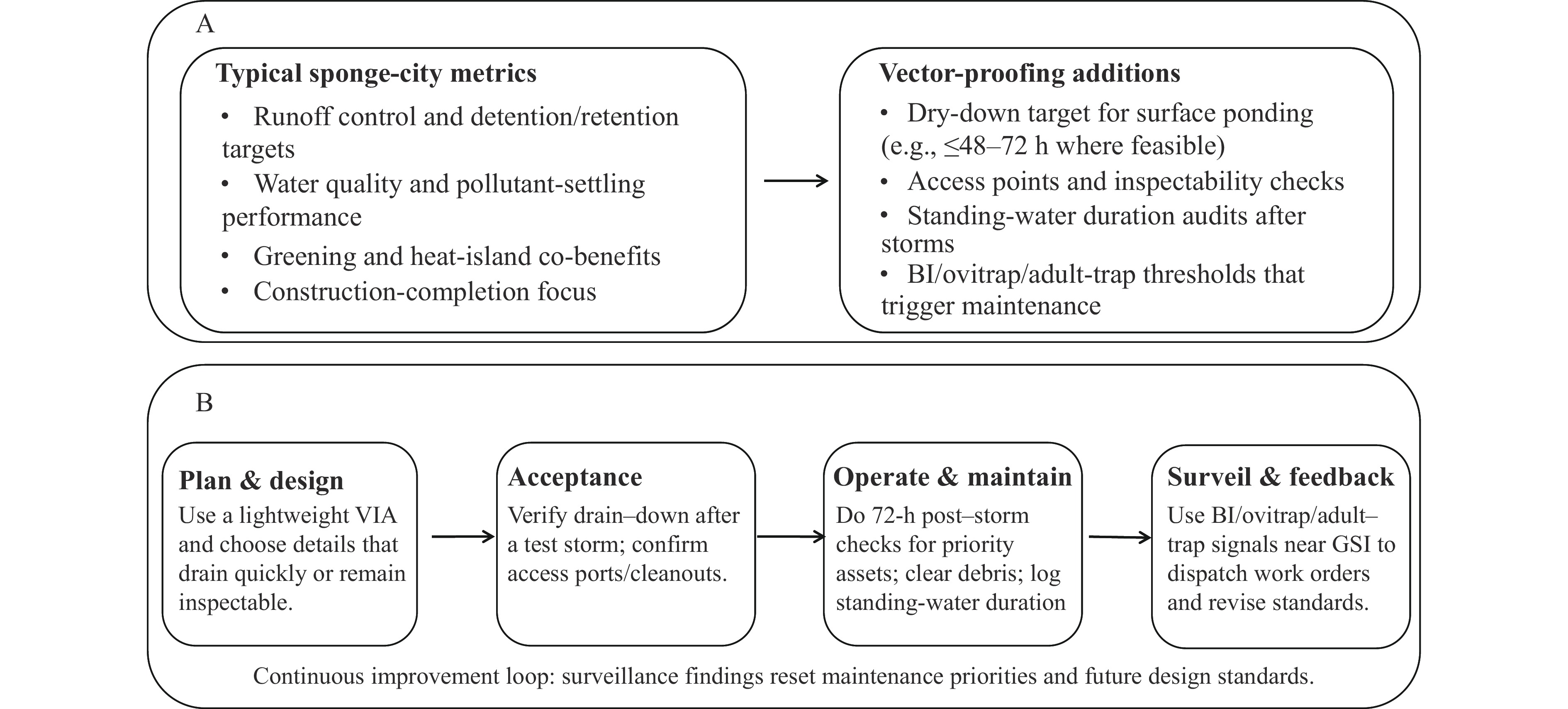 Figure 1.
Operational vector-proofing framework for sponge-city infrastructure, Guangdong Province, China, 2025. (A) Metrics gap: hydrology targets → vector-safe operating targets; (B) Implementation loop: embed indicators across the asset lifecycle.
-
This Perspective does not argue against sponge-city development; rather, it emphasizes the need to align climate-resilience investments with infectious disease prevention. The 2025 Guangdong outbreak illustrates that biological risk can emerge from routine infrastructure when residence time and inspectability are not actively managed (1–2). This rationale aligns with the China National Climate Change Health Adaptation Action Plan (2024–2030), which calls for interdepartmental coordination, surveillance capacity, and adaptation measures that explicitly address climate-sensitive health risks (8). Existing Aedes surveillance practice in China further demonstrates that entomological indicators can be linked to operational thresholds for maintenance and rapid response (6). Closing this gap requires an explicit implementation pathway: entomological indicators must be translated into engineering specifications and embedded at each lifecycle stage — planning and design, construction acceptance, and routine operation and maintenance. The division of responsibilities must be clearly delineated: housing and urban–rural development authorities should update civil engineering codes to mandate inspectability and physical barriers; water resources and municipal maintenance departments should execute routine clearing and audit standing-water duration; and health agencies (NHC and CDCs) should define entomological thresholds and conduct Vector Impact Assessments (VIA) prior to construction. This staged approach is also consistent with integrated vector-management principles emphasizing surveillance-based decision-making, intersectoral coordination, and adaptive operations across sectors (9).
-
To reconcile flood management with disease prevention, vector-proofing should be implemented as a staged package with explicit lead bodies, cost/complexity benchmarks, and timelines (Table 2). A conservative target of post-storm dry-down within 48–72 hours should be pursued where feasible for surface ponding, while high-risk structures unable to meet this target should require sealed design, inspectability, and additional vector-control measures. However, given Guangdong’s subtropical climate and heavy typhoon-season rainfall, gravity-driven soil infiltration alone may be insufficient in some high-risk settings; consequently, secondary interventions — such as completely sealed catch basin covers or embedded slow-release biological larvicides (e.g., Bacillus thuringiensis israelensis) — should be considered or may be required for selected high-risk drainage infrastructure (10). This target serves as an operational risk-reduction benchmark rather than a universal compliance threshold and should be adapted to local rainfall regimes, asset function, and the distinction between surface ponding and subsurface retained water.
Priority Action Lead bodies Cost Timeline NOW Sentinel GSI surveillance; BI/ovitrap/adult thresholds trigger work orders. Municipal CDC + city maintenance Low–Mod 0–6 months NOW 72-h post-storm checks for priority assets; clear debris; log standing-water duration. Maintenance contractors + water bureau Low 0–6 months NEXT Design/acceptance checklist: verify drain-down, eliminate cryptic pooling, require access ports. Housing/urban bureau + water + CDC Mod 6–18 months NEXT Lightweight Vector Impact Assessment (VIA) for new or retrofitted GSI in high-risk districts. Planning + housing/urban + CDC Mod 6–18 months LATER Revise local standards and procurement to add dry-down, inspectability, and trigger metrics; build a shared risk dashboard. Provincial/municipal standard bodies + NHC/CDC High 18–36 months Abbreviation: GSI=Green Stormwater Infrastructure; BI=Breteau Index; Mod=Moderate; h=hour; VIA=Vector Impact Assessment; NHC=National Health Commission. Table 2. Implementation Roadmap for Vector-Proofing of Sponge-City Infrastructure.
-
The 2025 Guangdong chikungunya outbreak — concentrated in Foshan City and Shunde District — underscores that climate adaptation infrastructure can create unintended arboviral risk when water residence time and inspectability are not operationalized (1). Vector-proofing offers a pragmatic extension of sponge-city practice: it introduces measurable dry-down and access indicators, links routine surveillance to maintenance dispatch, and clarifies cross-sector roles throughout planning, acceptance, and operation. Implementing these steps can reduce the likelihood that flood-resilience investments inadvertently shift risk toward Aedes-borne transmission, while generating the facility-level evidence needed to test and refine the proposed mechanism.
-
The National Health Talent Capacity Building Project of the Institute of Public Welfare and Philanthropy — the Elite Empowerment Program for Building a Healthy China (2025) — for its support.
HTML
Approach and Evidence Base
The Adaptation Paradox: Hydrology vs. Entomology
Mechanisms of Risk in Urban GSI
Policy Implications for Healthy China
Recommendations
| Citation: |

|