


 Download:




-
Introduction: In the summer of 2023, the world experienced unprecedented heat waves that broke previous records. As a typical sensitive area affected by global climate change, northern China is one of the most severely impacted regions.
Methods: This study used heat wave health risk assessment technology to estimate excess deaths from heat waves occurring in 420 counties in northern China in June 2023. We used 24-hour daily mean temperatures as an assessment indicator of heat wave exposure, which were derived from the National Meteorological Science Data Center. Demographic data were obtained from the Seventh National Population Census of China in 2020. Population mortality data were collected from the 2020 China Death Surveillance Dataset. Parameters from a time-series study on heat wave mortality risks across 272 Chinese cities were used to calculate the exposure-response relationship.
Results: In June 2023, 420 counties of northern China experienced a total of 599 heat waves, characterized by early onset, extreme heat intensity, long duration, and widespread impact. Heat wave-attributable excess mortality risk was 6.1 per million people, with the older persons aged ≥65 (4.7 per million people) and patients with cardiovascular diseases (5.6 per million people) more severely affected.
Conclusion: The June 2023 heat wave in northern China threatened the health of residents, especially the older persons and patients with cardiovascular diseases. These findings support the use of targeted warning systems and interventions to protect vulnerable populations in similar situations.
-
In the summer of 2023, the world experienced unprecedented heat waves that broke previous records (1). The global near-surface average temperature in 2023 was 1.45±0.12 °C higher than the average temperature from 1850 to 1900, breaking the previous record of the hottest years, 2016 and 2022, and the summer heat wave affected several regions of the northern Hemisphere (1). As a region typically sensitive to global climate change, northern China is one of the most affected areas because of its numerous densely populated large cities. In June 2023 alone, northern China suffered a record-breaking large-scale heat wave, with the average maximum temperature hitting a historical peak of the highest temperature since 1961. The temperature at 124 national meteorological stations exceeded 40 °C, of which 26 stations exceeded the historical extreme value (2), ranking first in China’s regional high temperature process over the past 33 years, which attracted great attention from the government, media, and the public.
To assess the health impacts associated with the June 2023 heat wave in northern China, we conducted a heat wave health risk assessment covering 420 counties across 36 cities in northern China (
Supplementary Table S1 ). Referring to the commonly used definitions of heat waves in climate change health studies (3–4), we defined a heat wave as an event in which the average daily temperature exceeds the 97.5th percentile of the historical baseline and lasts for two or more days. Using the average daily temperature from 2013 to 2020 as a historical baseline, we assessed the heat wave exposure characteristics of residents in the region and the excess mortality risk of the population in June 2023, and identified vulnerable populations and high-risk areas. Our findings can provide scientific evidence for the development of health protection measures and strategies for coping with heat waves in the future.To assess the exposure and health risks of heat waves over northern China from June 1 to June 30, 2023, we obtained 24-hour daily mean temperatures for 420 counties across 36 cities from the National Meteorological Science Data Center. When calculating the exposure-response relationship, the parameters were derived from a time-series study of heat wave mortality risks in 272 Chinese cities (4). Demographic data were obtained from the Seventh National Population Census of China in 2020, implemented by the National Bureau of Statistics of China. Population mortality data were collected from the Cause-of-Death Surveillance dataset of the National Cause-of-Death Surveillance System in 2020. The data cover annual mortality rates for nonaccidental, circulatory, and respiratory diseases in the total population, as well as mortality rates for males, females, and individuals aged 65 and above.
We quantified the mortality risk of local heat wave-affected populations in June 2023 using counties as the unit of assessment to calculate the number of excess heat wave-related deaths in each of the 420 counties using Equation (1). We then calculated the excess deaths associated with heat wave exposure in each city using Equation (2), followed by summation to estimate the total number of heat wave-related excess deaths in northern China. We also used Equation (3) to calculate the number of excess deaths due to heat waves per million people on a city scale, known as the excess mortality rate ($ EMR $). We performed sensitivity analyses using region-specific exposure-response coefficients for the Temperate Monsoon Zone derived from the same study of 272 Chinese cities (4).
$$ {M}_{i\mathrm{j}}=\left({RR}_{ij}-1\right)/{RR}_{ij}\times {POP}_{i}\times {Y}_{ij}\times {L}_{i} $$ (1) $$ {M}_{j}=\sum \limits_{i=1}^{n}{M}_{ij} $$ (2) $$ EMR=M_j/POP_i\times1000000 $$ (3) In these formulas, $ {M}_{ij} $ represents the number of heat wave-related excess deaths from a specific cause $ j $ in county $ i $ in June 2023. $ {M}_{j} $ represents the total excess deaths from a specific cause $ j $ associated with heat wave exposure in a given city. $ {RR}_{ij} $ refers to the relative risk of specific-cause death $ j $ related to heat waves in the county. $ {POP}_{i} $ represents the permanent resident population/subpopulation of the assessment area in county $ i $. $ {Y}_{ij} $ is the daily mortality rate for a specific cause of death $ j $ in county $ i $. $ {L}_{i} $ refers to the number of heat wave exposure days in county $ i $ in June 2023, and $ n $ indicates the number of counties in a particular city. $ EMR $ denotes the number of excess deaths per million people due to heat wave exposure at the city scale. The R Statistical software (version 4.0.2; Kurt Hornik and R Core Team, Vienna, Austria) was used to perform all analyses.
Table 1 shows the summary statistics of heat wave exposure and heat wave intensity in 420 counties in northern China in June 2023. During the study period, 599 heat waves occurred across the 420 counties. Compared with the same period in previous years, the heat wave in June 2023 exhibited four typical characteristics: early onset, wide impact, high heat intensity, and long duration. As early as June 14, a large-scale heat wave occurred, affecting 37 counties in Beijing, Hebei, Shaanxi, and Inner Mongolia provincial-level administrative divisions (PLADs). Throughout June 2023, 334 counties experienced heat waves, accounting for 79.5% of the total number of counties. A total of 225 counties in Beijing, Tianjin, central Inner Mongolia, and most of Hebei Province have experienced two or more heat waves. Eighty-three counties in Beijing, Tianjin, central Hebei Province, and southeastern Inner Mongolia had daily maximum temperatures exceeding 40 °C three times or more, and 34 of those counties had daily maximum temperatures exceeding 40 °C five times or more. In terms of duration, 133 counties in Beijing, Tianjin, central Inner Mongolia, and most of Hebei Province experienced heat waves lasting four days or more. After June 21, heat waves in Chifeng City and the Xilin Gol League in Inner Mongolia PLAD lasted for six days.
Region Frequency of heat waves Number of heat wave days Number of heat wave days per county Number of counties exposed to ≥1 heat wave (proportion %) Number of counties exposed to ≥2 heat waves (proportion %) Number of counties exposed to extreme heat* for ≥3 days (proportion %) Number of counties exposed to extreme heat* for ≥5 days (proportion %) 420 counties 599 1,803 4 334 (79.5) 225 (53.6) 83 (19.8) 34 (8.1) Inner Mongolia 138 426 4 89 (86.4) 49 (47.6) 0 (0) 0 (0.0) Beijing 38 133 8 16 (100.0) 16 (100.0) 13 (81.3) 5 (31.3) Tianjin 32 97 6 16 (100.0) 16 (100.0) 13 (81.3) 1 (6.3) Shanxi 62 165 1 49 (41.9) 13 (11.1) 0 (0) 0 (0.0) Hebei 329 982 5 164 (97.6) 131 (78.0) 57 (33.9) 28 (16.7) Note: * Extreme heat refers to a daily maximum temperature ≥40 ℃. Table 1. Summary statistics of heat wave exposure in 420 counties of northern China, June 2023.
Figure 1 shows the results of the heat wave population health risk assessment and the spatial distribution of the excess mortality risk from nonaccidental diseases attributable to heat waves across the five provinces/municipalities. Heat waves resulted in 1,036 excess deaths. High-risk areas are concentrated in Beijing (9.84 per million people), Tianjin (7.35 per million people), Hebei Province (7.01 per million people), and Inner Mongolia (5.22 per million people) PLAD. Older persons and patients with cardiovascular diseases are at high risk of heat waves. Moreover, heat waves with longer duration, greater intensity, and wider coverage exert more severe health impacts. Between June 21 and 27, a large-scale extreme heat wave occurred, affecting 332 counties in 32 cities, with an estimated 614 excess deaths, accounting for 59.2% of the excess deaths from nonaccidental diseases caused by the heat wave that month. Baoding and Chengde of Hebei Province experienced a heat wave that lasted for five consecutive days from June 21 to 25, whereas Chifeng and Xilin Gol League of Inner Mongolia experienced a heat wave that lasted for six days from June 22 to 27. These heat waves across the four cities affected a total of 1.82 million people in 7 counties, and the estimated excess mortality risk attributable to the heat wave was 6.2 per million people.
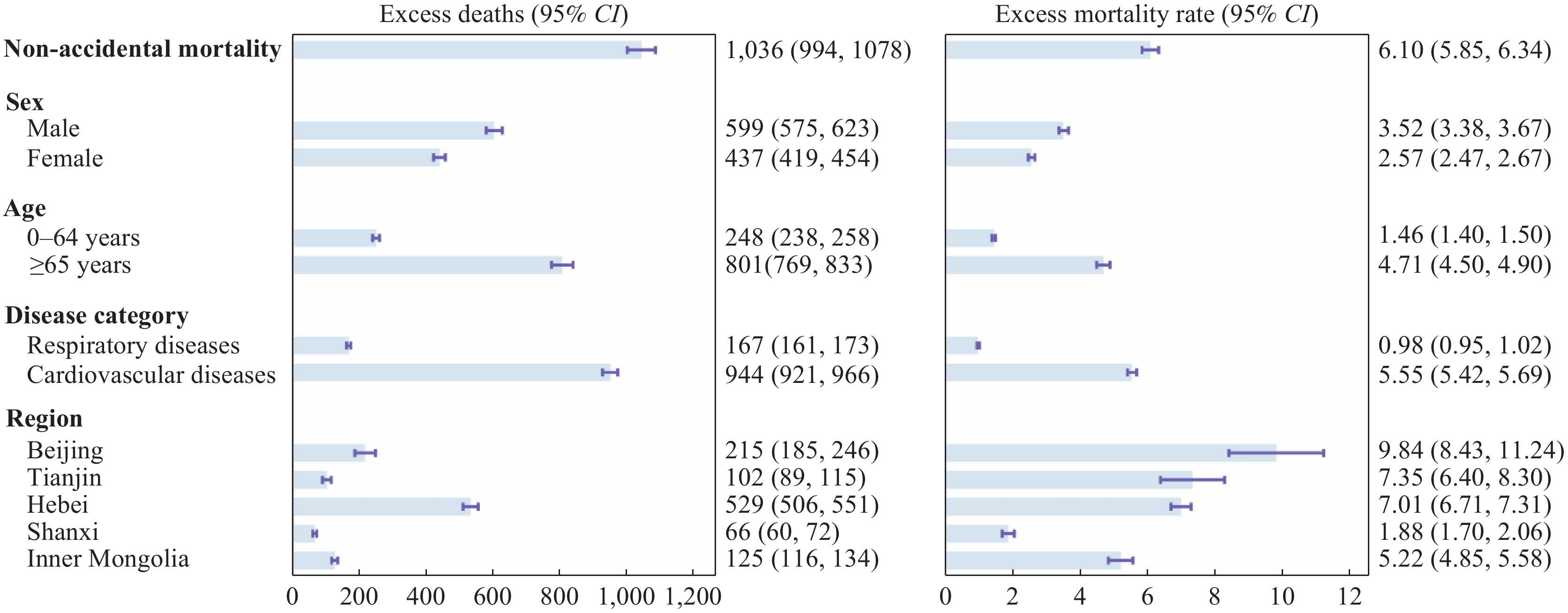 Figure 1.
Excess deaths and excess mortality rate due to heat waves in 420 counties of northern China in June 2023.
Abbreviation: CI=confidence interval.Supplementary Table S2 presents the sensitivity analysis of excess deaths from nonaccidental diseases estimated using the exposure-response parameters for the Temperate Monsoon Zone. Given that the relative risk for this climate zone was comparable to the national average, the estimated number of excess deaths derived from region-specific parameters showed no statistically significant difference from the main analysis, while exhibiting wider confidence intervals. -
The first heat wave in northern China in June 2023 had the characteristics of early onset, long duration, and large scale and the risk was more prominent. The risk of death from the first heat wave was significantly higher than that from subsequent heat waves (5-6). A study of 43 communities in the United States found a 5.04% increase in all-cause mortality during the first heat wave and a 2.65% increase in subsequent heat waves compared with non-heat wave days (5). A study of 130 counties in China also showed that the first heat wave increased the overall risk of death by 16.3% and the risk of cardiovascular death by 23.8% (6). This may be because when the first heat wave arrives, the human body has not yet formed a heat adaptation mechanism, including the failure of body temperature regulation functions (such as vasodilation and sweating to respond in time) and people’s behavior to adapt to heat lags (such as not increasing the use of air conditioning and not reducing outdoor activities). Since the national average exposure-response relationship parameter was used in this assessment, the actual risk of death from the first heat wave is likely to be even higher than that reported in our results; therefore, the health hazards of the June 2023 heat wave in northern China should be treated seriously.
The older population and patients with cardiovascular diseases are at high risk of exposure to large-scale heat waves (7–9). Older persons are at a higher risk of dying from heat waves, and the mechanisms include the deterioration of thermoregulatory function due to aging, underlying medical conditions, and long-term use of drugs that impair heat adaptation, as well as delayed access to cooling facilities and untimely medical care due to economic or mobility restrictions (7). For patients with cardiovascular disease, Chaseling et al. (9) demonstrated that heat waves can cause skin vasodilation (resulting in increased cardiac output) and dehydration (leading to increased blood viscosity), both of which together increase the heart workload. Heat waves can also induce systemic inflammatory responses, promote thrombosis, and exacerbate acute cardiovascular events. We recommend that older people and those with cardiovascular diseases should be included in the core population for heat wave protection, and risk interventions and health protection should be implemented early in the summer to reduce their health risks.
To effectively respond to heat waves, the National Bureau of Disease Control and Prevention issued the Guidelines for Public Health Protection of Heat Waves to guide the public to take scientific precautions, and the health department has implemented multichannel science popularization and education to enhance public awareness and prevention of heat health risks. To address the growing health threat of heat waves under global warming trends, there is an urgent need for action to strengthen heat wave resilience, reduce the risk of death, and prevent the onset of allergies, especially for early warnings and timely responses to such early onset, long-duration, and large-scale heat waves. We recommend strengthening the capacity of disease control agencies for the early warning of thermal health risks. Therefore, population health risk assessment mechanisms should be further improved to consolidate the foundation of risk management. Simultaneously, a normalized popular science education system should be established to continuously enhance the public awareness of protection.
This study has several limitations. First, national-level parameters were selected to ensure statistical stability, as the source dataset already encompassed the study region. While potentially overlooking regional heterogeneity, sensitivity analyses confirmed that region-specific estimates were consistent with the main results, but had wider confidence intervals due to smaller sample sizes; thus, our estimates serve as robust approximations. Second, we estimated excess deaths based on the 97.5th percentile definition (≥2 days) because coefficients for alternative definitions (e.g., 95th, 99th) were either unavailable or statistically insignificant in the source study. While enabling a comprehensive subgroup assessment, this limits its applicability to other definitions, warranting future research on varying heat wave characteristics. Finally, as a rapid assessment following technical guidelines, this study did not quantify the mitigating effects of adaptation measures (e.g., public education or cooling infrastructure).
-
This study did not involve human subjects, animal experiments, informed consent, private data, or any other content requiring an ethical review. The authors declare that the research was conducted in compliance with academic norms and that the data were authentic and reliable.
HTML
| Citation: |

|