


 Download:




-
As a cornerstone of public health, immunization enables people of all ages to live longer, healthier lives while alleviating the socioeconomic burden of infectious diseases worldwide (1–3). China formally launched the Expanded Program on Immunization (EPI) in 1978, and since then, both the variety and volume of vaccines in use have grown rapidly alongside broader promotion of immunization knowledge and heightened public awareness of proactively seeking vaccination information. Public demand has since expanded to encompass vaccine availability, rational immunization schedules, adverse event counseling, and personalized vaccination guidance — issues that have emerged as prominent focal points of public concern (4–5). In response, government consultation hotlines have evolved into vital, direct channels for public opinion monitoring and risk communication, enabling health authorities to promptly capture emerging needs and address public concerns as they arise.
As a rapidly urbanizing metropolis with a large and demographically diverse population, Suzhou faces unique complexities in immunization program management — most notably, coordinating cross-regional vaccination for migrant children and addressing varied demand for both EPI and non-EPI vaccines. This study analyzed immunization consultation hotline data from the Suzhou CDC spanning 2018 to 2024, with the goal of identifying key public concerns, persistent challenges, and emerging hot topics. The findings are intended to provide data-driven evidence for optimizing service allocation, refining targeted intervention strategies, and enhancing both the quality and responsiveness of EPI work in Suzhou.
-
The Basic Information Hotline operates daily from 9:00 to 17:00, serving Suzhou City residents exclusively via telephone. All calls are handled by professionally trained staff who undergo regular training and are based at the Suzhou CDC. Hotline personnel collaborate closely with hospitals and vaccination clinics to address issues promptly — referring complex vaccination-related inquiries to specialists and managing complaint-related cases within designated feedback timeframes. Every call is answered on time by qualified professionals in a dedicated room, with all content recorded for subsequent reference and verification. The standardized workflow follows four sequential stages: call registration, data classification, results follow-up, and data archiving. Data were extracted from daily hotline records spanning a 7-year period (2018–2024). Only immunization-related valid calls (n=76,154) were included in the analysis; non-relevant inquiries — such as administrative, non-immunization issues — were excluded during preliminary screening. Two trained public health researchers independently reviewed the records to extract core topics, and any classification discrepancies were resolved through consultation with a third senior epidemiologist from Suzhou CDC.
Natural language processing (NLP) was applied to preprocess the text data, encompassing digitization, data cleaning, and removal of invalid information. This pipeline also defined categorical data features and computed term frequencies prior to systematic analysis. All structured outputs were organized in standard Microsoft Excel 2025 (Microsoft Corporation, headquartered in Redmond, USA). Descriptive statistical analyses — including frequency counts, constituent ratios, and temporal trends — were subsequently performed, and all figures were generated using Python (version 3.12.1, Python Software Foundation, based in Wilmington, USA).
-
Between 2018 and 2024, hotline call volume fluctuated and peaked at 15,365 in 2021 before declining sharply to 3,025 in 2024 — an 80% drop from the peak. The years 2019–2021 consistently sustained high volumes, each exceeding 13,937 calls per year (Figure 1A). Monthly call volumes exhibited clear seasonality, with peaks occurring from May through September and troughs in January and February (Figure 1B). Annual word clouds of consulted vaccines — in which font size reflects relative frequency — revealed distinct phase characteristics across the study period: during 2018–2019, high-interest vaccines centered on HPV, RV, DTaP-IPV-Hib, and pediatric/adult HepB; during 2020–2022, public inquiries shifted toward targeted pandemic-related concerns, while non-COVID-19 vaccine consultations declined significantly; and during 2023–2024, high-interest vaccines returned to pre-pandemic patterns (Figure 2). Figure 3 presents the year-by-year volume of vaccine-specific calls, organized into nine categories: Non-EPI vaccines (encompassing vaccination knowledge, vaccine safety, and protective efficacy); EPI vaccines; Supply and Price; Vaccination Services (including clinic locations, booking methods, and operating hours); adverse events following immunization (AEFI); Contraindications (contraindicated scenarios and vaccination for special populations); Vaccination Policy; Assessment Form-related; and COVID-19-related (
Supplementary Tables S1–S2 ). Assessment form-related inquiries were the most frequent, accounting for 24,911 calls (32.71%), followed by vaccination services at 15,387 calls (20.21%) and vaccination policies at 15,026 calls (19.73%) (Figure 4).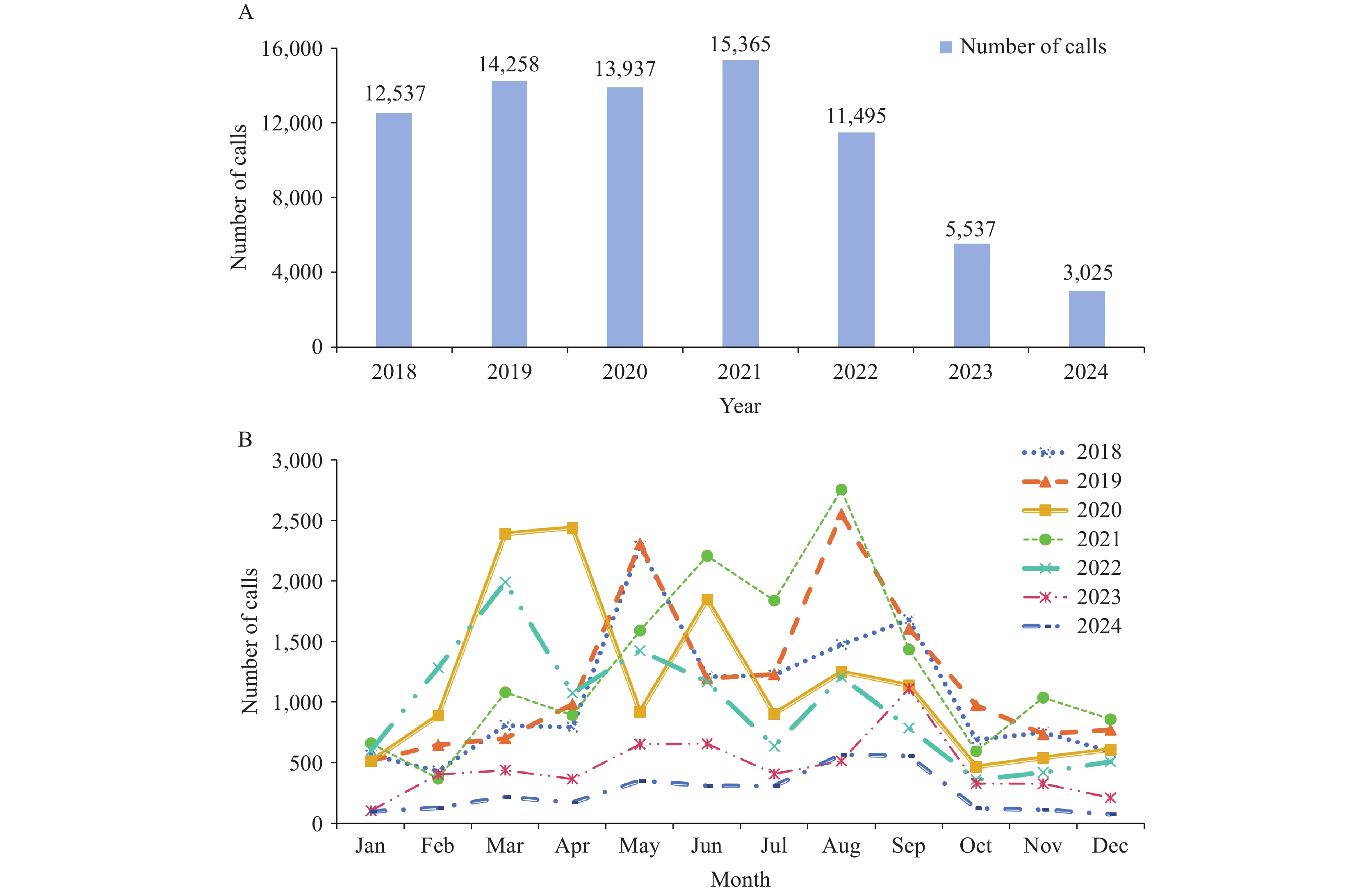 Figure 1.
Hotline call volumes in Suzhou from 2018 to 2024. (A) Annual call counts; (B) Monthly call counts.
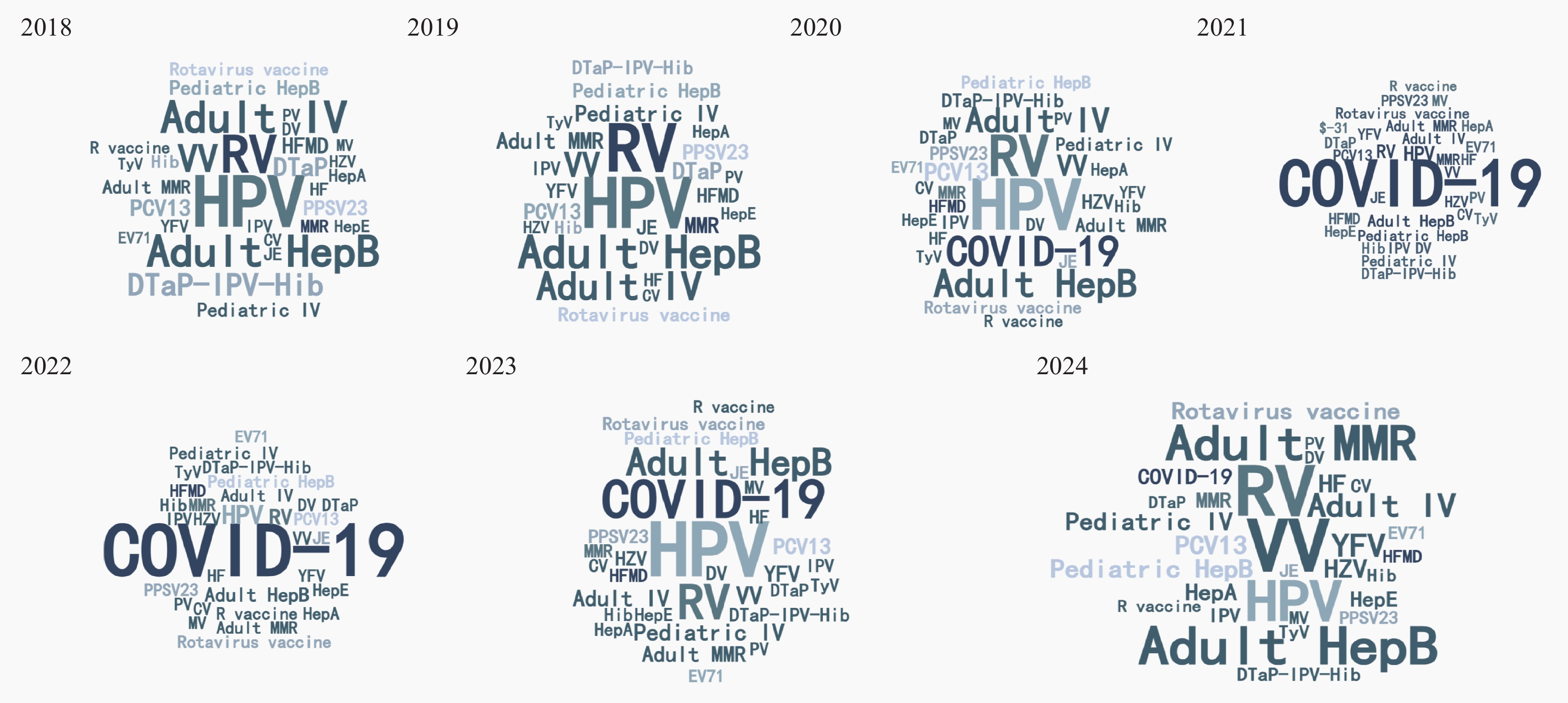 Figure 2.
High-interest vaccines identified through annual word cloud analysis, Suzhou, 2018–2024.
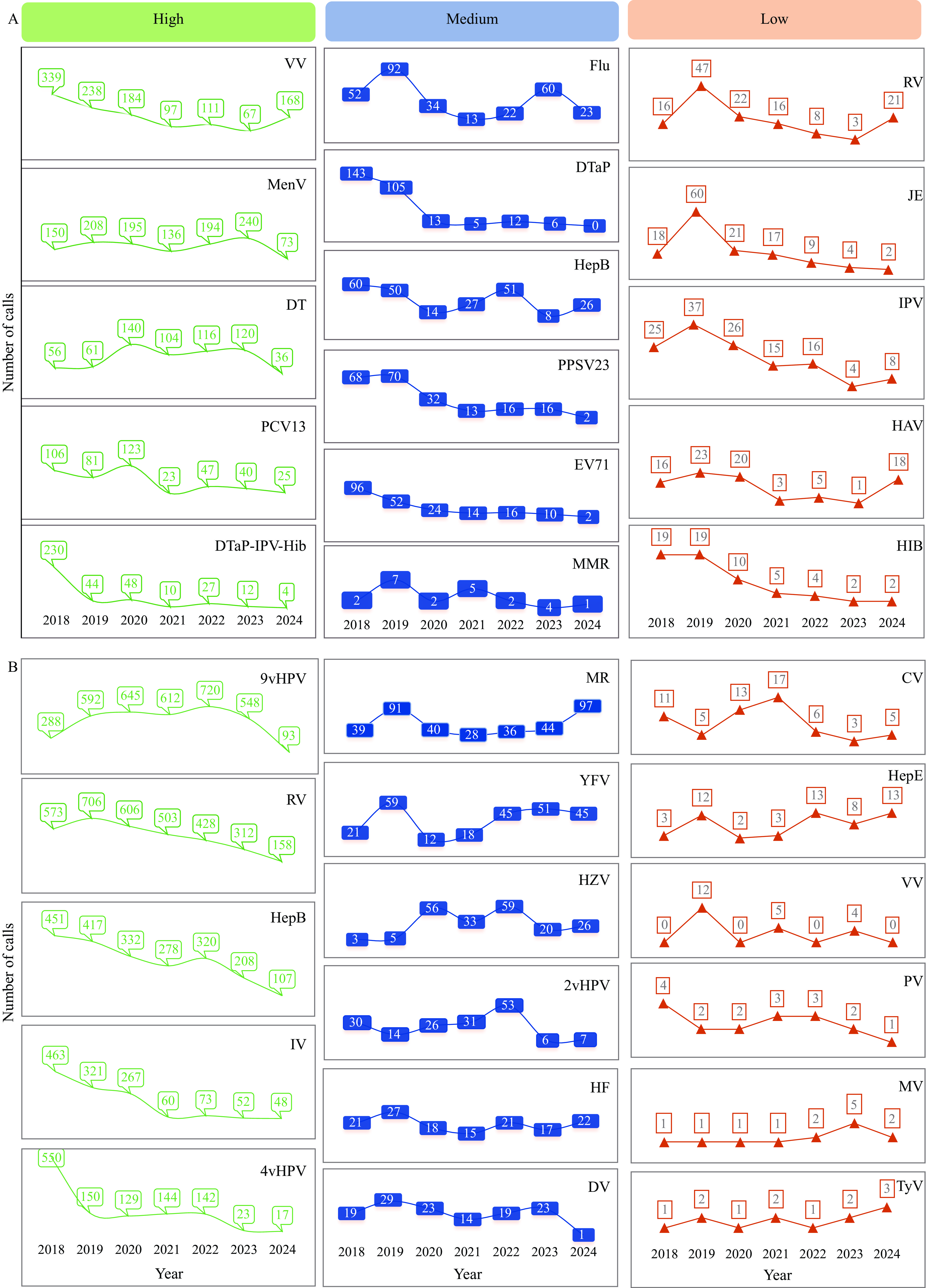 Figure 3.
Frequency trend classification of consulted vaccines in Suzhou, 2018–2024. (A) Pediatric-related vaccines; (B) Adult-related vaccines.
Abbreviation: 2vHPV=2-valent Human Papillomavirus vaccine; 4vHPV=4-valent Human Papillomavirus vaccine; 9vHPV=9-valent Human Papillomavirus vaccine; CV=Cholera vaccine; DV=Dengue vaccine; HF=Hemorrhagic Fever vaccine; HepB=Hepatitis B vaccine; HEV=Hepatitis E vaccine; HZV=Herpes Zoster vaccine; IV=Influenza vaccine; MV=Malaria vaccine; MR=Measles and Rubella vaccine; MenV=Meningococcal vaccine; PV=Plague vaccine; RV=Rabies vaccine; TyV=Typhoid vaccine; VV=Varicella vaccine; YFV=Yellow Fever vaccine.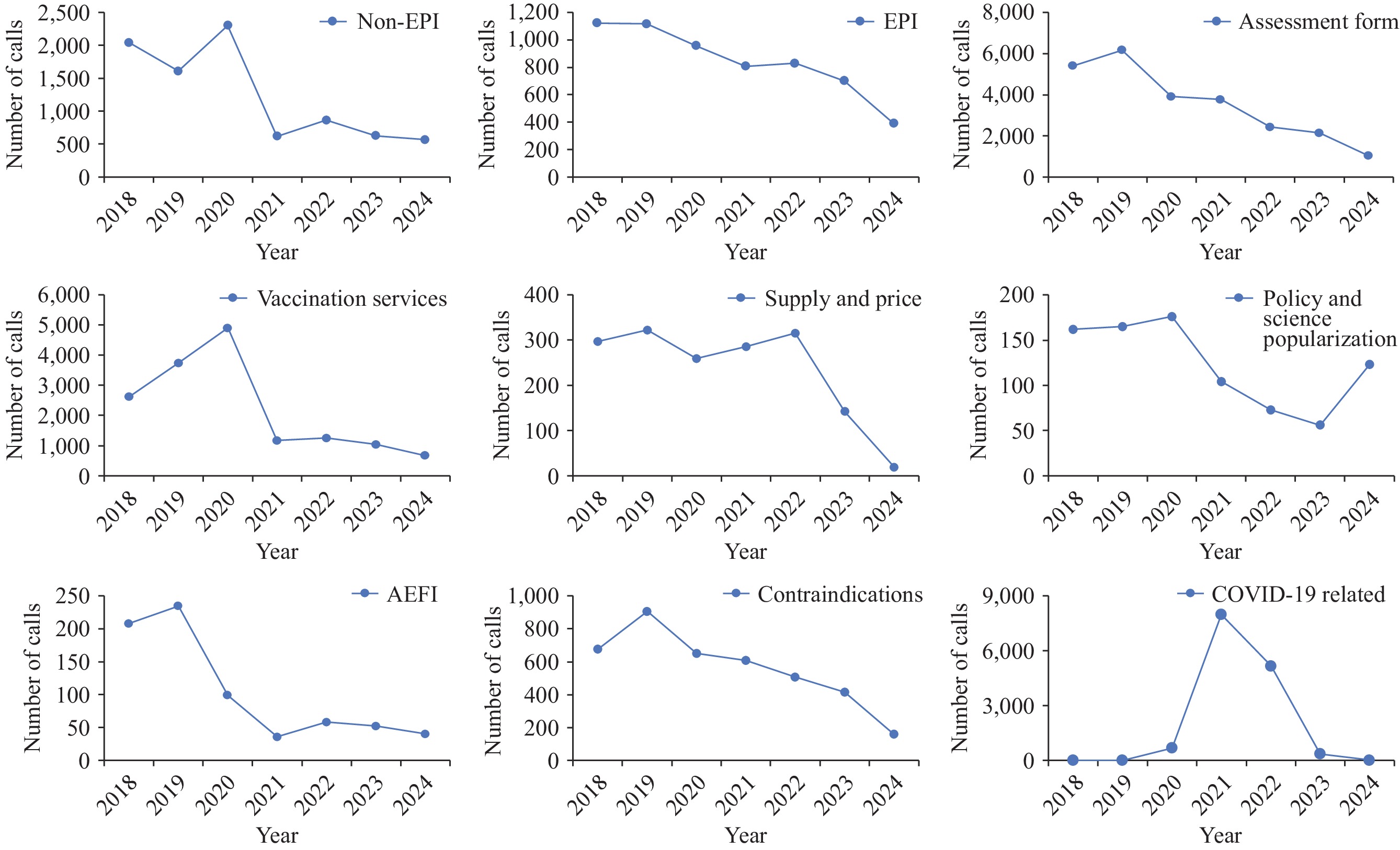 Figure 4.
Annual trends in hotline call categories in Suzhou City, Jiangsu Province, China, 2018–2024.
Abbreviation: EPI=expanded program on immunization; AEFI=adverse events following immunization; COVID-19=coronavirus disease 2019. -
This study represents the first long-term, continuous longitudinal analysis of government immunization consultation hotline calls in China, encompassing over 70,000 calls recorded in Suzhou between 2018 and 2024. The dataset serves as a measure of the overall effectiveness of immunization program hotlines, while also reflecting the concerns and advice-seeking behavior of self-initiated callers (6). Word cloud analysis and vaccine consultation frequency trend classification identified human papillomavirus vaccines (HPV), rabies vaccines (RV), and 13-valent pneumococcal conjugate vaccines (PCV13) as the hotspot vaccines. This pattern likely stems from early supply shortages and heightened public interest, both of which initially drove inquiry volumes upward, whereas subsequent supply stabilization and improved public health awareness contributed to a gradual decline in consultation volume (7).
In China, all childcare institutions, kindergartens, and primary schools are required to verify the vaccination certificates of newly enrolled children. Suzhou introduced digital support for this verification process in 2016, whereby parents submitted printed vaccination assessment forms to schools for authentication during the designated enrollment period (May–September). Initially, both schools and parents were unfamiliar with the new system, which drove consultation volumes to a peak of 6,174 calls in 2019. However, city-wide awareness campaigns, professional training, and iterative system optimization gradually equipped parents and school staff with greater proficiency in the workflow, and related consultation volumes began to decline steadily from 2020 onward. This downward trend indicates that the assessment form evaluation system has been progressively refined, thereby enhancing service accessibility (8–10). Nevertheless, vaccination certificate consultations remain a perennial focal point each year, owing to Suzhou’s large floating population, whose newly arrived children require card registration and file establishment upon entry into the city’s school system.
Vaccination services — encompassing the distribution of vaccination clinics, booking methods, and operating hours — along with non-EPI vaccines, including vaccination knowledge, vaccine safety, and protective efficacy, accounted for the most frequent consultation categories in 2020. This pattern is largely attributable to COVID-19-related disruptions, such as the suspension of clinic vaccination services and insufficient vaccine supplies during the pandemic. In Cambodia, the Hotline 115 system played a pivotal role in CCDC’s response to and management of the COVID-19 pandemic (11). Consultations regarding vaccination policies emerged as the most frequent category in 2021, particularly those related to the implementation of relevant pandemic policies (12). Following 2020, the volume of immunization consultation hotline calls trended downward — a shift likely driven by the rapid advancement of the internet and digitalization, which has granted the public access to a diverse range of vaccination-related information channels (e.g., vaccination appointment mini-programs and WeChat Official Accounts), alongside optimized service delivery. The trends observed in vaccination services and vaccination policies reflect dynamic public demands, as well as the timeliness and effectiveness of local immunization service improvements, both of which may contribute to greater public willingness to vaccinate. Studies have demonstrated that enhanced vaccination knowledge among child guardians positively reduces vaccine hesitancy (13–14). The hotline therefore plays an indispensable role in immunization program communication, with staff professionalism and service quality serving as key factors in building public trust. Effective communication fosters a virtuous cycle of engagement — and over the years, our hotline service has earned widespread acclaim across all sectors of society.
This study has several limitations. The immunization consultation hotline relies exclusively on verbal communication, which precludes the transmission of supplementary information such as text and images. Furthermore, consultations are constrained by call duration, and callers may face queuing delays during peak hours.
The hotline has supported immunization program across multiple dimensions. The declining call volume reflects positive feedback on improvements in work quality and efficiency, rather than a diminishment of service value. As social informatization continues to advance, public expectations for health service quality are rising, and vaccination concerns evolve alongside shifting public opinion trends (13). It is therefore essential to build professional, high-performing vaccination service teams and to deliver multi-channel, diversified consultation services capable of providing refined, personalized support. To this end, we propose the following practical recommendations: 1) strengthening the professional knowledge and competency of staff; 2) establishing a knowledge base for high-concern topics; 3) optimizing and expanding digital service platforms; and 4) intensifying public health education efforts. Together, these measures will enhance immunization service quality and advance public health outcomes in Suzhou.
HTML
| Citation: |

|