


 Download:




-
Introduction: Rooftop water-holding containers are breeding sites for Aedes mosquitoes but are often inaccessible for routine surveillance in densely populated urban settings. This study assessed the feasibility and operational value of unmanned aerial vehicle (UAV) surveillance prior to the dengue season in Dongguan, China.
Methods: Repeated cross-sectional surveys were conducted between April and July in 2024 and 2025 in randomly selected villages and communities. A total of 100 rooftops per site were inspected using UAVs. Among households with UAV-identified water-holding containers, 10% were randomly selected for onsite validation. Entomological indices were calculated. No sampling weights were applied.
Results: UAVs surveyed 4,700 rooftops and identified water-holding containers in 24.3%. The inspection time averaged 22.2 minutes per 100 rooftops, reducing field workload by 67.7% compared with traditional methods. Storage containers for plant watering accounted for 62.9% of detected containers. On-site validation revealed larvae in 18.2% of containers, with seasonal increases from April to July. No significant interannual differences were observed (P>0.05).
Conclusion: UAV-assisted surveillance enhanced operational efficiency and reliably identified rooftop breeding risks. Integrating UAV scanning into routine pre-season vector surveillance and implementing targeted removal of identified containers may strengthen early dengue prevention in urban communities.
-
Dengue and chikungunya, transmitted predominantly by Aedes mosquitoes, remain critical public health concerns in tropical and subtropical regions. In Guangdong Province, southern China, climatic conditions conducive to year-round vector proliferation increase the risk of local outbreaks of imported infections will seed local outbreaks (1). Effective vector surveillance is therefore critical, yet conventional door-to-door inspections have become increasingly difficult, as urban residents adopt stronger privacy norms and restrict access to residential rooftops, which are often overlooked but important sources of Aedes breeding.
To address these operational constraints, the Dongguan Center for Disease Control and Prevention has explored the use of unmanned aerial vehicles (UAVs) as a novel surveillance tool for detecting rooftop water-holding containers. This study assessed the feasibility, efficiency, and epidemiological value of UAV-assisted surveillance as an approach complementary to conventional vector control strategies.
We conducted repeated cross-sectional surveys in randomly selected villages and urban communities in Dongguan, southern China, from April to July in 2024 and 2025, corresponding to the months preceding the dengue transmission season. The study sites were selected by simple random sampling from a list of all registered villages and urban communities in Dongguan to ensure broad geographic coverage. Within each selected site, 100 residential rooftops were systematically surveyed using unmanned aerial vehicles (UAVs) (DJI Mavic Air 2), irrespective of household characteristics. Each month, two UAVs scanned residential rooftops to identify potential mosquito breeding sites, defined as any visible water-holding container. From households identified by the UAV as having water-holding containers, 10% were randomly selected for onsite rooftop inspection by trained vector control personnel to validate UAV findings and assess larval positivity.
We quantified the rooftop breeding site burden using standard entomological indices. The roof index (RI) is defined as the proportion of rooftops with at least one water-holding container among all rooftops inspected by the UAV. For households visited onsite, the house index (HI) represents the proportion of inspected rooftops with at least one larva-positive container, the container index (CI) represents the proportion of containers found to contain larvae, and the breteau index (BI) represents the number of larva-positive containers per 100 houses inspected.
All data were entered into Excel 2024 (Microsoft, USA) and analyzed using SPSS (version 25.0; IBM Corp., Armonk, NY, USA). Differences among entomological indices were assessed using the Kruskal–Wallis test, and temporal differences across months were examined using t-tests. Statistical significance was defined as a two-sided P<0.05.
UAV surveillance has demonstrated markedly greater operational efficiency than traditional onsite inspections (Figure 1). As shown in Table 1, scanning 100 rooftops required a mean of 22.16 minutes (range 12.5–40.0 minutes), whereas conventional onsite inspection required an average of 305 minutes (range 250–650 minutes). This difference corresponds to a 67.7% reduction in field workload when UAV imagery is used to guide targeted inspections. Efficiency patterns were consistent across 2024 and 2025.
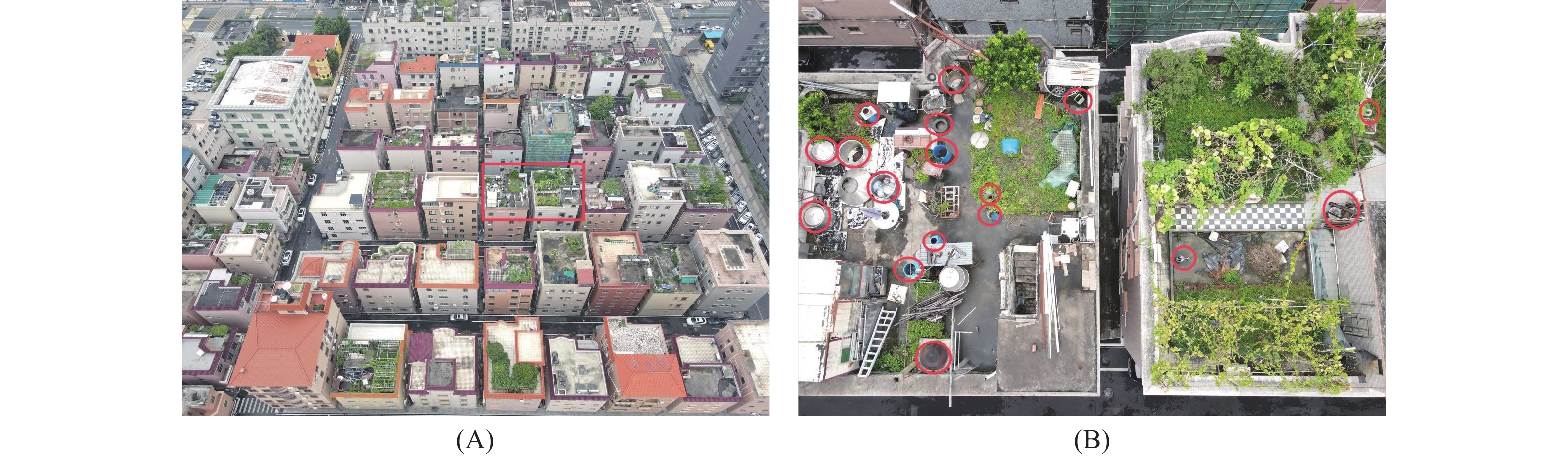 Figure 1.
UAV imagery of residential rooftops. (A) Overview showing rooftop vegetable and flower planting; (B) Close-up view highlighting water-holding containers (circled).
Abbreviation: UAV=unmanned aerial vehicle.Year UAV surveillance time (min per 100 rooftops) On-site inspection time (min per 100 households) Minimum Maximum Mean Minimum Maximum Mean 2024 12.50 30.00 19.85 250 550 309 2025 14.00 40.00 24.38 250 650 303 Total 12.50 40.00 22.16 250 650 305 Abbreviation: UAV=unmanned aerial vehicle. Table 1. Comparison of time required for UAV surveillance and on-site household inspection.
Across both survey years, the UAVs assessed 4,700 rooftops, of which 21.79% had rooftop planting (7.74% vegetable planting; 14.04% flowers) (
Supplementary Table S1 ). UAV imagery identified 1,143 households with at least one water-holding container, corresponding to an overall roof index (RI) of 24.32 (19.70 in 2024; 28.75 in 2025). A total of 1,711 containers were documented (Supplementary Table S2 ), dominated by storage containers used for watering plants (62.95%), followed by idle containers (29.05%), structural water pooling (6.02%), and tires (1.99%). Monthly analysis (Figure 2A–D) showed that RI remained relatively stable from April to July, whereas larval indices (BI, HI, and CI) exhibited the expected seasonal increase, being consistently lowest in April and rising from May through July in both years.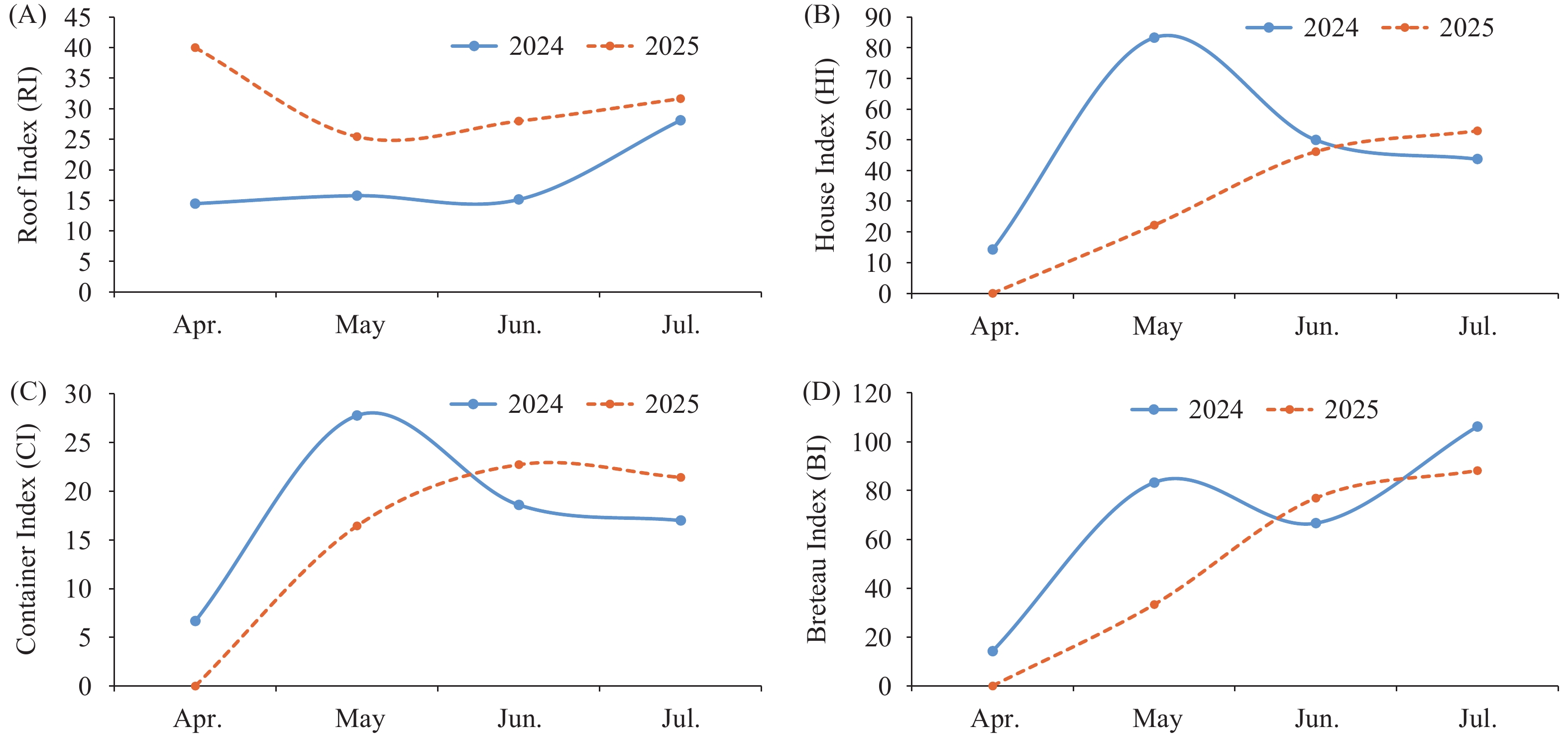 Figure 2.
Monthly distribution of rooftop surveillance indices: (A) RI; (B) HI; (C) CI; and (D) BI, for 2024 and 2025.
Abbreviation: RI=roof index; HI=house index; CI=container index; BI=breteau index.Among the 111 households selected for on-site validation, inspectors identified 374 containers (mean 3.37 per household), including 68 larvae-positive containers (mean 0.61 per household). The on-site-derived indices were, HI 37.84, CI 18.18, and BI 61.26 (
Supplementary Table S3 ). Although the RI, HI, CI, and BI differed numerically between years, these differences were not statistically significant (H=6.67; P>0.05). This concordance supports the good agreement between UAV-detected container presence and ground-verified entomological indices. -
This study showed that UAV-assisted rooftop surveillance is a feasible, efficient, and epidemiologically informative approach for identifying Aedes breeding sites in densely populated urban settings. By rapidly scanning high-rise rooftops, which are traditionally inaccessible and frequently overlooked, UAVs detected a substantial burden of water-holding containers, particularly plant-watering storage vessels and idle miscellaneous containers. The consistently elevated Roof Index across months suggested that rooftop container availability remained stable throughout the pre–dengue season, whereas the seasonal rise in on-site larval indices indicated increasing larval productivity from April to July. These findings demonstrate that UAVs can identify breeding site precursors earlier than conventional entomological surveys, thereby offering a timelier indication of vector proliferation risk.
Consistent with previous reports from other settings, UAV-guided surveillance also markedly reduced the field workload (2–3). The 67.7% reduction in on-site inspection requirements represents a significant operational advantage in communities where access barriers and privacy concerns have increasingly hindered traditional door-to-door inspections. The alignment between UAV-detected containers and ground-verified entomological indices further supports UAV surveillance as a reliable method for characterizing rooftop-level Aedes infestation. In Guangdong, where dengue and chikungunya transmission is closely linked to the introduction of imported cases (4-5), earlier and more comprehensive risk detection could strengthen preparedness and enable targeted vector control operations (6).
Within this operational and epidemiological context, the visually different monthly trajectories of the RI, HI, CI, and BI observed between 2024 and 2025 (Figure 2) likely reflect normal interannual variability rather than systematic differences in surveillance performance or transmission risk. Year-to-year variation in early-season temperature and rainfall may have shifted the timing and magnitude of larval amplification. Meanwhile, differences in rooftop planting practices and water-storage container availability, which are more prominent in 2025, may explain the higher early-season RI values and a lagged increase in larval indices. Variability in the timing or intensity of routine vector control activities may have further contributed to the divergence between the container-based and larval-based indices. Importantly, despite these visual differences, no statistically significant differences in entomological indices were detected between years, suggesting that the observed patterns represent the expected interannual fluctuations.
These findings highlight the epidemiological relevance of rooftop environments (7). Despite being invisible in ground-based surveys, rooftops harbored diverse water-holding containers and supported measurable larval activity (7). As urbanization continues and rooftop usage increases, routine surveillance of rooftop environments may become increasingly important for dengue prevention (8-9).
The findings have at least three limitations. First, the UAV imagery did not permit direct confirmation of larval presence, and the selection of households for on-site validation may have introduced sampling errors. Nonetheless, the close correspondence between RI and on-site larval indices suggests that UAV detection of container presence is a reasonable proxy for entomological risk. Second, although on-site rooftop inspections were conducted to validate the UAV-detected breeding sites, this study did not link the entomological findings to dengue or chikungunya cases at the household level. The surveys were conducted as part of routine pre-season vector surveillance and were not designed to capture individual-level clinical outcomes. In addition, the limited number of households undergoing on-site inspections and low incidence of reported cases during the study period precluded meaningful correlation analyses. Furthermore, surveillance was conducted during the pre-dengue season (April–July) and did not extend into the peak transmission period (August–October). This study was designed to assess the value of UAV-assisted surveillance for the early detection of rooftop breeding site risks before routine emergency vector control activities are intensified. Consequently, these findings may not reflect the entomological conditions during peak transmission months when container availability and larval indices are strongly influenced by reactive interventions. Fifth, UAV visibility was influenced by rooftop structure, vegetation, and physical obstruction, which may have led to small or concealed containers being missed. Sixth, differences in the specific villages selected between the survey years may have contributed to the interannual variability in the entomological indices, although the same sampling framework was applied in both years. Finally, the study was conducted in a single city over two years, which may limit its generalizability to regions with different urban forms, household practices, or regulatory environments.
These analyses suggest that UAV-assisted rooftop surveillance can provide a rapid and scalable strategy for identifying water-holding containers that could serve as potential breeding sites for Aedes [2, 3]. Integrating UAV-based scanning into routine vector surveillance might strengthen early-season detection of entomological risk, improve operational efficiency by guiding targeted field deployment, and enhance the precision of community-level interventions. In settings where residential access is restricted or where high-rise housing is predominant, UAV surveillance could complement established entomological monitoring systems and reinforce preparedness for dengue and chikungunya transmission. More broadly, UAV-supported surveillance may help advance earlier, more targeted, and more resource-efficient vector control programs (10).
In conclusion, UAV-assisted rooftop surveillance is an efficient and reliable method for identifying potential Aedes breeding sites in densely populated urban areas. These findings suggest that the incorporation of UAVs into routine vector surveillance can enhance early risk detection and support targeted dengue control efforts.
HTML
| Citation: |

|