


 Download:




-
Introduction: Severe fever with thrombocytopenia syndrome (SFTS) is a tick-borne viral disease caused by the Dabie bandavirus (DBV), which is traditionally endemic in rural agricultural and tea plantation areas. The expansion of suitable tick habitats into urban green spaces raises concerns regarding urban transmission.
Methods: In June 2025, two confirmed cases of SFTS were reported in an urban district of Nanjing, China. A Centers for Disease Control-led field investigation was conducted, including epidemiological investigations, environmental assessments, tick monitoring, and molecular analyses.
Results: Both cases involved elderly urban residents with no rural exposure or animal contact. Case 1 developed symptoms on June 11, recovered, and was discharged on June 19. Case 2 developed symptoms on June 17 and fully recovered by June 28. Neither patient experienced severe complications. At Case 2’s location, tick density was 4.0 ticks/100 m·h; 83.3% (10/12) tested positive for DBV, whereas at Case 1’s site, tick density was 1.25 ticks/100 m·h and all ticks tested negative. Sequencing of the L, M, and S segments showed 99.4%–100% nucleotide similarity between patient- and tick-derived strains, indicating locally acquired infection and sporadic natural DBV foci in urban environments.
Conclusion: The high DBV-positive rate in ticks from urban green spaces provides strong evidence of localized viral circulation, indicating the potential for SFTS transmission in urban environments. Our findings provide scientific support for targeted urban tick surveillance, vector control measures, and increased clinical awareness.
-
Severe fever with thrombocytopenia syndrome (SFTS) is a tick-borne viral disease historically confined to rural regions characterized by agricultural and tea plantation landscapes; it poses a significant threat to both human and animal health (1-2). Recent studies suggest that suitable tick habitats have expanded to urban green spaces, particularly recreational parks (3). In Nanjing City, Jiangsu Province, SFTS cases have shown an upward trend accompanied by geographic expansion into more towns and subdistricts. Given the rarity of cases and limited epidemiological evidence, the risk of SFTS exposure in urban settings remains poorly understood. On June 13 and 23, 2025, two SFTS cases were reported in the urban district of Nanjing, prompting the Nanjing municipal CDC and the district CDC to initiate a field investigation. The core scientific question of this study is whether natural DBV foci exist in urban green spaces. Based on these findings, this study further evaluated the potential implications for public health strategies.
-
Case 1: An 82-year-old woman, reported no travel outside her residential community for 14 days before symptom onset (May 28–June 10, 2025), with only vegetable cultivation in residential garden plots. She reported no contact with patients with SFTS or their close contacts. On June 11, she developed a high fever and sought care at a tertiary hospital. The initial hematological test results were inconclusive. On June 12, her condition deteriorated and she was transferred to another tertiary hospital, where thrombocytopenia was detected (38×109/L). On June 13, the DBV nucleic acid test returned positive results, confirming the diagnosis of SFTS. Meanwhile, progressive thrombocytopenia was observed (14×109/L), accompanied by elevated cardiac enzymes, hepatic transaminases, and increased intracranial pressure. The patient was transferred to the infectious disease unit for symptomatic and supportive care. On June 19, case 1 tested negative for DBV nucleic acids test and was discharged. The complete epidemiological timeline is illustrated in Figure 1A.
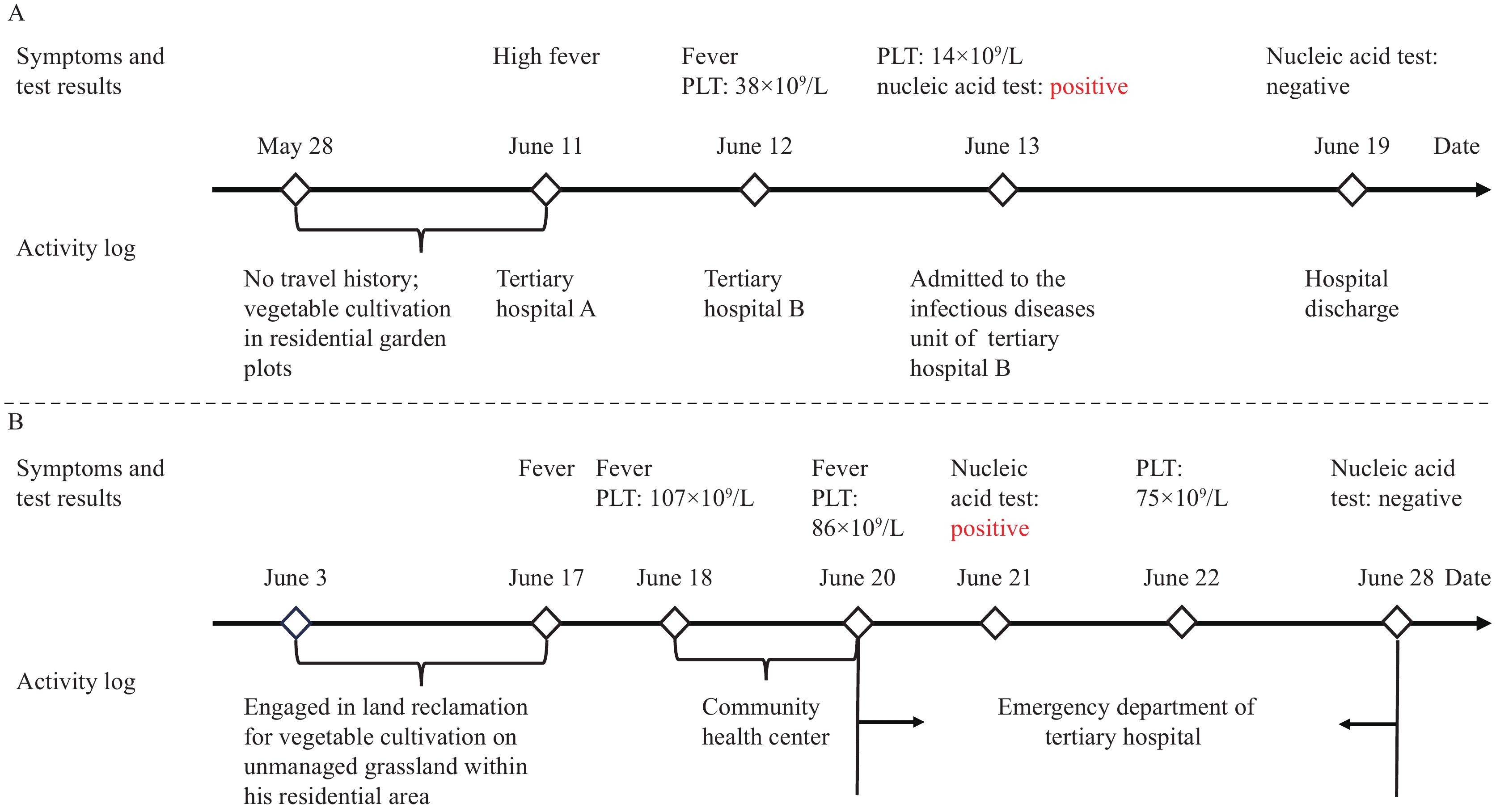 Figure 1.
Epidemiological timeline of two SFTS cases in urban area — Nanjing City, Jiangsu Province, China, 2025. (A) Case 1; (B) Case 2.
Abbreviation: PLT=platelet; SFTS=severe fever with thrombocytopenia syndrome.Case 2: A 75-year-old man, lived approximately 1.2 km north of the patient in Case 1. Two weeks before illness onset (June 3−16, 2025), he had no travel or mountain excursions but reclaimed unmanaged grassland within his residential area for vegetable cultivation. He reported no contact or close contact with patients with SFTS. On June 17, he developed a fever and visited a community health center on June 18. Initial tests revealed mild thrombocytopenia (107×109/L). Despite symptomatic treatment, his condition persisted with fever and worsening thrombocytopenia (86×109/L), prompting referral to a tertiary hospital on June 20. Nucleic acid testing confirmed DBV infection on June 21. From June 20–22, his platelet count further declined (75×109/L), accompanied by diarrhea, abdominal pain, and generalized myalgia. Case 2 received daily infusion therapy in the hospital emergency department until June 28 when the nucleic acid test was negative (Figure 1B).
Both patients reside in foothill neighborhoods in central urban areas. (Figure 2A). Case 1’s residential complex included 13 buildings, 180 households, and approximately 350 residents. Case 2’s residential complex comprised 27 buildings, 1,000 households, and over 3,000 residents. Both communities featured abundant grassland and shrub vegetation suitable for tick habitats.
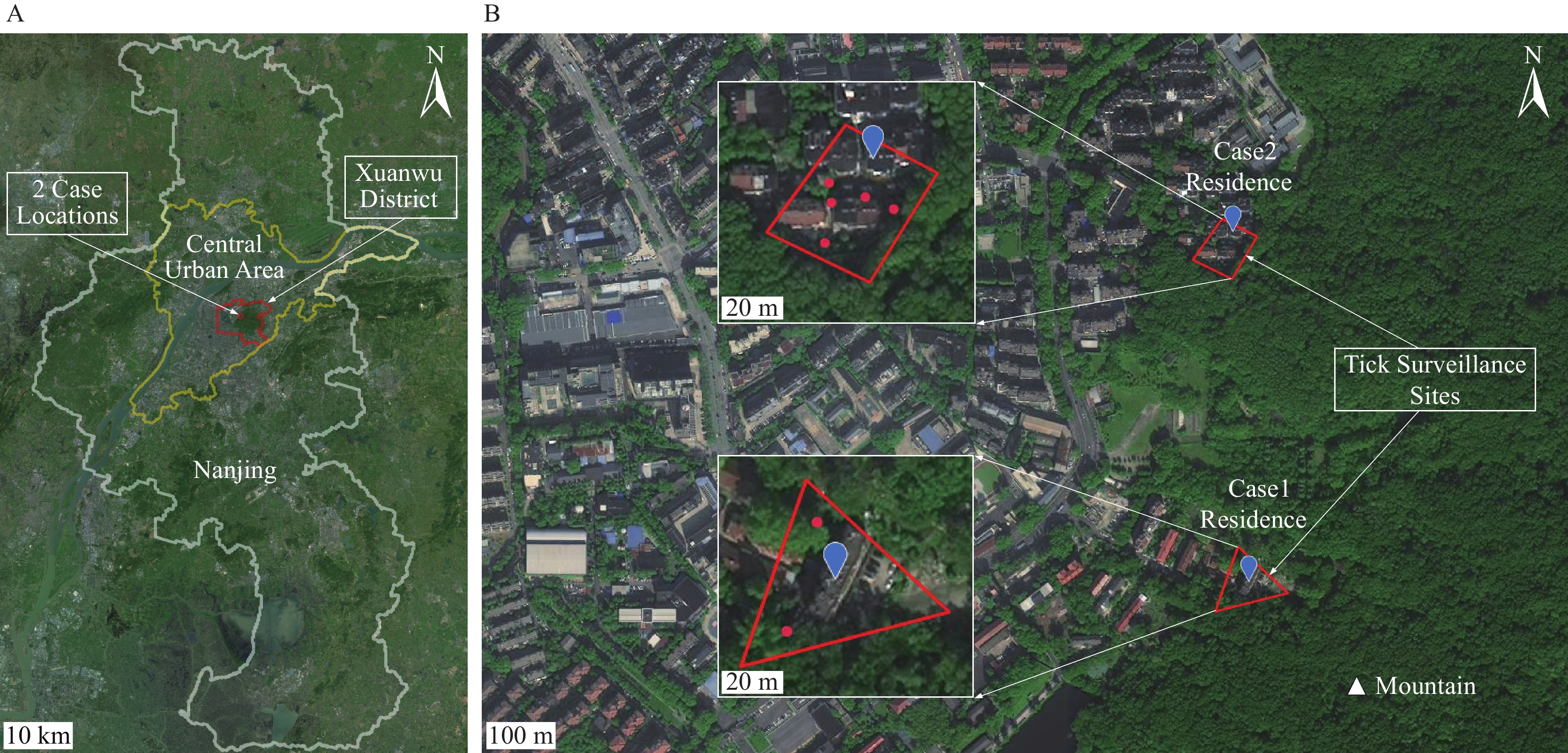 Figure 2.
Geographic locations and environmental features of the two SFTS cases in Xuanwu District, central Nanjing City, Jiangsu Province. (A) Geographic location of Xuanwu district in Nanjing city; (B) Geographic distribution of two cases and surveillance sites.
Abbreviation: SFTS=severe fever with thrombocytopenia syndrome.The municipal and district CDCs conducted tick surveillance on June 14 and 23 in areas associated with two confirmed SFTS cases. Sampling sites were selected based on the national vector surveillance guidelines issued by the China CDC, which prioritize grassy patches and low shrubs within the daily activity zones. Tick collection was performed at 9∶30 a.m. to avoid direct sunlight exposure. Three trained field investigators participated in each of the sampling sessions. Eight sites were sampled, including vegetable plots, grassy slopes at the foot of the mountains, residential green spaces, forest edges, and walking paths (Figure 2B). A standardized flagging method using a 90 cm × 60 cm white flannel cloth combined with manual capture was employed. At each sampling site, dragging was conducted along predefined transects for a distance of at least 500 meters and for a duration of at least 30 minutes. The collected ticks were stored in tubes until further testing. Tick density was calculated as ticks per 100 meters per person-hour (ticks/100 m·h). A total of 17 ticks were collected. All the five ticks from Case 1’s sampling sites (density: 1.25 ticks/100 m·h) were tested negative for DBV. However, 10 of the 12 ticks obtained from Case 2’s sampling sites (4 ticks/100 m·h) were DBV-positive using Reverse Transcription-Polymerase Chain Reaction (RT-PCR). Morphological identification was performed according to the “Handbook for Classification and Identification of Main Vectors”, using features such as body segments, mouthparts, and legs (4). By comparing these characteristics with reference atlases, the predominant ticks were confirmed to be Haemaphysalis longicornis. Ticks were found in green spaces surrounding the patients’ residences, which coincided with their routine walking paths. DBV-positive ticks were detected within approximately 100 meters of the residence in Case 2 and within approximately 500 meters of the residence in Case 1. Neither case reported recent contact with animals or pet ownership. Although some residents of the community owned dogs, no tick infestation was observed upon examination of the animals’ ears.
Viral RNA was extracted from patient serum samples and tick homogenates, and DBV was detected using real-time RT-PCR. Whole-genome sequencing was performed using a bunyavirus whole-genome capture kit (Hangzhou Baiyi Technology Co. Ltd., China). Sequencing libraries were prepared using a Nextera XT kit (Illumina, USA) and sequenced on an Illumina MiniSeq platform using a High Output Reagent Kit (300 cycles). Raw reads were assembled using CLC Genomics Workbench 22.0.2. Only assemblies with an average depth ≥100× and genome coverage ≥90% were retained. Sequence alignment and homology analysis were performed using MEGA 5.2. Sequence analysis demonstrated that the viral strains from Case 1 shared 99.7%, 99.7%, and 99.4% nucleotide similarity with the tick-derived strains in the L, M, and S segments, respectively. In Case 2, sequencing of the L segment was unsuccessful; however, the M and S segments showed 99.9% and 100% similarity, respectively, with the strains isolated from tick monitoring. The results showed a high degree of genetic consistency between patient- and tick-derived DBV strains.
-
A series of strategies and measures have been implemented in Nanjing to control the prevalence of SFTS in urban areas (Figure 3). Generally, multiple local departments swiftly mounted coordinated responses. The responses focused on personnel management, tick control, and environmental remediation. These were supported by targeted health education and collaboration across sectors and were adapted to urban settings.
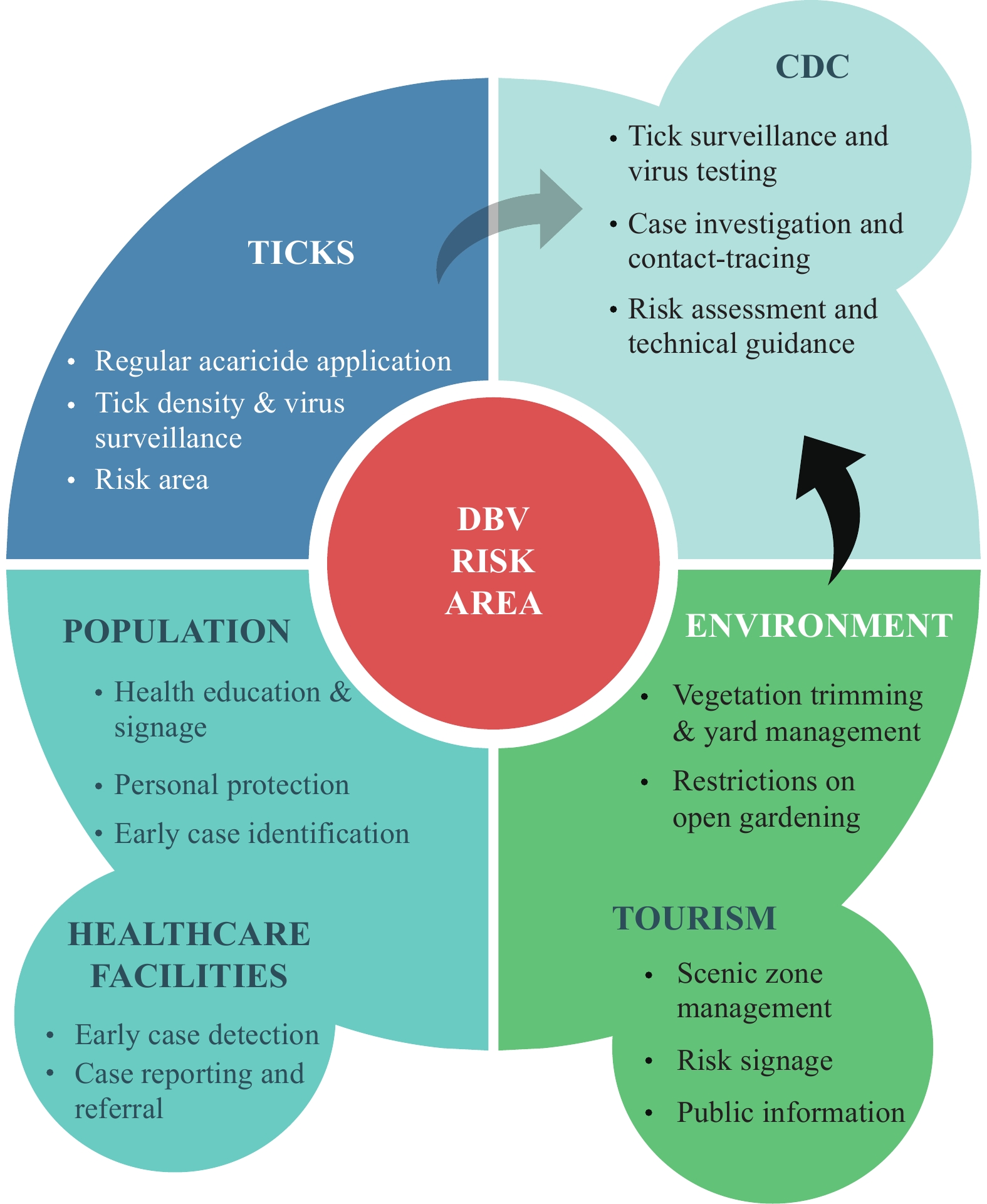 Figure 3.
Multi-level infection control strategy for urban SFTS cases.
Abbreviation: DBV=Dabie bandavirus; SFTS=severe fever with thrombocytopenia syndrome.In terms of personnel management, occupational protection training was provided to the scenic area staff and migrant workers, and household outreach was conducted among local residents. The public was advised to adopt personal protective behaviors and deworm pets regularly to reduce exposure to ticks. Tick control measures have targeted common urban tick habitats, including mountain trails, residential gardens, and green belts. Routine acaricide application was implemented along with ongoing surveillance of tick density and DBV positivity to support precise risk area delineation. Additionally, preventive tick control measures were implemented in other urban areas with similar ecological characteristics. Environmental remediation involves clearing potential tick-breeding sites and installing warning signs to reduce the exposure risk. Health education was conducted through community engagement, scenic area broadcasts, and new media platforms to raise awareness among residents and tourists.
-
Through combined epidemiological and microbiological evidence, this report documents cases of locally acquired SFTS in the urban core of a major city in China. Both patients were elderly residents living in central Nanjing whose daily activities were confined to walking within residential green spaces and cultivating vegetables in community gardens. They had no recent travel to rural or hilly endemic areas and had no history of SFTS or animal contact. Environmental surveillance detected DBV-positive ticks approximately 100 meters from the residence in one case, and sequence analysis demonstrated a high degree of genetic consistency between the patient- and tick-derived strains. These findings strongly suggest that natural foci of DBV may have established sporadically in urban environments, highlighting an emerging infection risk for foothill neighborhood residents and the particular vulnerability of elderly individuals with reduced mobility in well-vegetated urban communities.
Since its discovery, SFTS has mainly been reported in rural areas dominated by agricultural and tea plantation areas (5-6). Ecological changes have recently facilitated the expansion of tick habitats into urban areas, raising concerns about urban transmission (3). In 2024, 6 locally acquired SFTS cases were reported in Beijing’s rural–urban fringe. Although DBV-positive ticks and hedgehogs were detected in urban parks in Beijing, no such cases were reported in urban core areas, possibly because of the low abundance of Haemaphysalis longicornis (7). In contrast, the present study provides the first systematic evidence supporting local transmission and the probable establishment of natural foci within a densely populated and highly urbanized city center. This distinction may reflect variations in urban ecological structure and different stages of tick vector adaptation across metropolitan environments. However, the occurrence of urban cases does not necessarily indicate a recent introduction of the virus into the city but may also reflect previously unrecognized or under-detected transmission under suitable ecological conditions. Therefore, continuous surveillance and systematic risk assessment are essential for accurately characterizing the extent and intensity of urban transmission. Despite the urban setting, several characteristics of the present cases were consistent with those reported in rural SFTS studies. Both infections occurred during the typical seasonal peak. Haemaphysalis longicornis was identified as the predominant tick species, and exposure was linked to low-vegetation outdoor environments. These consistencies indicate that the fundamental transmission pattern of SFTS remains unchanged, despite the urban context.
Nanjing experiences a subtropical monsoon climate with hot and rainy summers (8-9). Ongoing urban greening initiatives have resulted in a persistently high vegetation coverage. Urban green spaces, including scenic areas, recreational parks, and community landscapes, are widely distributed across cities and frequently overlap with residential environments. Nanjing is situated along the East Asian-Australasian flyway through which migratory birds regularly pass and interact with local urban ecosystems (10). Together, these climatic and ecological characteristics may act as key driving forces that facilitate tick survival, host availability, and viral maintenance in urban environments. The combination of favorable microclimatic conditions, abundant urban green spaces, and the introduction of infected ticks via migratory birds may jointly promote the establishment and persistence of urban DBV natural foci (11–13). Nevertheless, the relative contributions and interactions of these drivers warrant further investigation through multi-season and multisite ecological and pathogen surveillance studies.
Although urban transmission remains rare, this study has important implications for public health. First, it highlights the need to establish standardized diagnostic and treatment pathways for SFTS in urban areas. Clear protocols for case recognition, testing, treatment, referral, and reporting should be developed to ensure a timely diagnosis and appropriate case management. Training healthcare providers is necessary to strengthen early detection and rapid responses. Second, tick surveillance should be implemented in urban scenic areas and parks to assess the tick density and DBV prevalence, with priority given to zones with previously documented infections. Scenic spots, parks, and residential communities in urban areas should also be prioritized for environmental remediation. Third, targeted health education should be conducted in scenic spots and well-greened residential communities, including setting up warning signs and posters and strengthening awareness of SFTS protection and healthcare-seeking behaviors among urban residents.
This study was subject several limitations. First, the small number of confirmed urban cases and tick samples limit the generalizability of our findings. Second, although ticks were investigated, systematic surveillance of potential animal hosts in urban environments was not conducted, restricting our ability to fully characterize the local transmission cycle of DBV. Third, the limited sample size precluded a comprehensive phylogenetic analysis, preventing the reconstruction of the evolutionary history of the virus and its relationship with other known strains. Future studies with expanded tick and animal host sampling, combined with long-term surveillance, are needed to better understand DBV maintenance, transmission pathways, and the evolving risk of SFTS in urban areas. Additionally, with a larger sample size, phylogenetic analyses can be performed to further elucidate the evolutionary history of the virus and its relationship with other regional and global strains.
HTML
| Citation: |

|