


 Download:




-
Introduction: Foodborne disease incidence peaks during summer months when elevated temperatures and humidity create optimal conditions for pathogen proliferation. Cold-processed pastries represent particularly high-risk foods due to their susceptibility to bacterial contamination. Between May and June 2025, multiple foodborne disease outbreaks occurred across Shandong Province, all epidemiologically linked to durian mille-feuille cakes from a single franchise brand.
Methods: Centers for Disease Control and Prevention in three cities (Qingdao, Yantai, and Tai’an) conducted comprehensive epidemiological investigations from May to June 2025. Investigations included structured patient interviews, supply chain traceback analyses, and laboratory testing employing whole genome multilocus sequence typing (wgMLST) for high-resolution pathogen characterization.
Results: Twenty-two confirmed cases were identified across the three cities, with a median age of 30 years; 64% of cases were female. Laboratory analysis identified Staphylococcus aureus producing enterotoxins A through D as the causative pathogen. wgMLST analysis demonstrated that clinical isolates, food samples, and food handler isolates differed by only 0–3 alleles across gene loci, indicating exceptionally high genetic relatedness. Epidemiological and molecular evidence identified food handlers as the probable contamination source rather than raw materials.
Conclusion: This multi-city outbreak resulted from durian mille-feuille cakes contaminated by food handlers carrying S. aureus. The franchise business model, characterized by decentralized production and independent ingredient sourcing, contributed to the prolonged temporal span and geographic dispersion of the outbreak. We recommend strengthening hygiene controls throughout the cold-processed pastry production chain, including enhanced employee health surveillance, standardized hand hygiene protocols, and strict temperature control during storage and transport.
-
On June 18, 2025, during routine surveillance of the foodborne disease outbreak reporting system, we identified a foodborne disease outbreak reported by Pingdu CDC on June 16 that involved consumption of durian mille-feuille cakes from a specific franchise brand. Recognizing the potential for multi-city transmission through this franchise network, we immediately contacted Qingdao CDC to evaluate preliminary findings and coordinate response measures. We subsequently expanded case searches through the foodborne disease surveillance system and initiated comprehensive investigations to determine the outbreak’s etiology and extent, and to implement appropriate control measures.
-
Individuals who developed one or more of the following symptoms — nausea, vomiting, diarrhea (≥3 bowel movements per 24 hours with altered stool consistency), or abdominal pain — after consuming food from a franchise outlet between May 28 and June 23, 2025. A total of 22 cases were confirmed across three cities (Qingdao, Yantai, Taian). During May and June, CDCs in these cities conducted standardized questionnaire surveys of affected patients.
The Qingdao outbreak involved a single family who purchased durian mille-feuille cake on May 27. One family member developed illness on May 28 but self-medicated without seeking medical attention. Three additional family members developed symptoms on May 29.
The Yantai cases comprised five distinct exposure groups. Group 1 consisted of a three-member household who purchased and consumed the cake on June 7; all three subsequently developed illness. Group 2 involved work colleagues who purchased the cake on June 7 and shared it; both consumers became ill. Group 3 included employees from another company who purchased the cake on June 8; one employee who consumed the cake became ill, while two colleagues who also consumed it remained asymptomatic. Groups 4 and 5 each involved separate households who purchased cakes on June 8. In both groups, patients consumed refrigerated leftover cake on June 9 and subsequently developed symptoms. In Group 4, the patient consumed the remaining half of the cake. In Group 5, the patient’s son consumed a small portion on June 8 without becoming ill, while the patient consumed the remaining cake the following day and developed symptoms.
The Taian cases involved three separate families. In Family 1, three members became ill after consuming durian mille-feuille cake purchased on June 21. In Family 2, three members developed symptoms following consumption of cake purchased on June 22. In Family 3, five members fell ill after eating cake also purchased on June 22. Notably, all household members who consumed the durian mille-feuille cake became ill, while those who did not consume it remained healthy.
The median patient age was 30 years (range: 9–61 years), with 14 cases (64%) being female. Illness onset dates spanned from May 28 to June 23, 2025 (Figure 1).
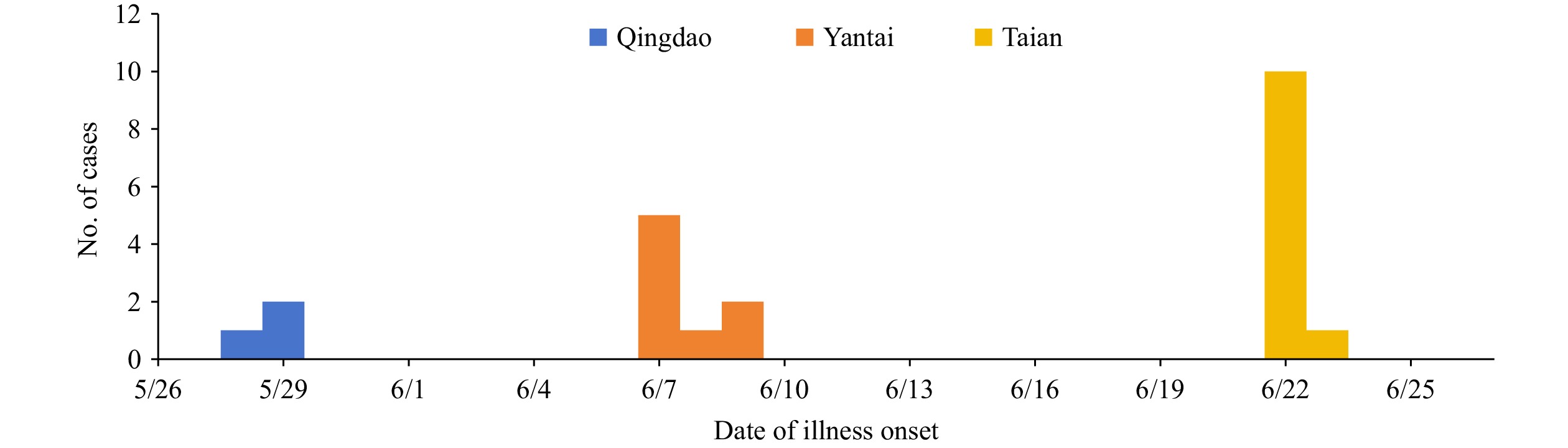 Figure 1.
Number of persons (N=22) by date of illness onset — three cities, Shandong Province, China,May 28–June 23, 2025.
Clinical manifestations are detailed in Table 1. No severe cases or deaths occurred. A total of 16 patients sought medical care, while 6 self-managed their symptoms at home. Food exposure investigation revealed that all 22 cases had consumed durian mille-feuille cakes. Among family members and friends who shared meals with cases, 7 individuals consumed the cakes but did not develop illness, while all individuals who did not consume the cakes remained healthy.
Symptom No. Percentage (%) Diarrhea 22 100.00 Abdominal pain 21 95.45 Vomiting 18 81.82 Nausea 16 72.73 Headache 5 22.73 Dizziness 2 9.09 Chills 1 4.55 Table 1. Clinical manifestations of cases in an outbreak of Staphylococcus aureus infections — Shandong Province, May–June 2025 (N=22).
-
Qingdao, Yantai and Tai'an CDC investigators conducted site visits to cake shops where patients had purchased and consumed durian mille-feuille cakes. During these visits, they collected environmental swabs, equipment samples, and employee specimens, while performing comprehensive traceback investigations to identify the sources of remaining cakes and their constituent raw materials, including all ingredient distributors. This brand operates through a franchise model in which individual stores receive training at headquarters before opening outlets under the brand name. Critically, headquarters does not centrally distribute raw materials or finished products; instead, each franchise store independently procures all required ingredients. Supply chain analysis revealed that three franchise stores across Qingdao, Yantai, and Weihai cities sourced pitted durian flesh from Thailand through the same supplier, while all other ingredients came from different sources. Although all franchise stores were required to purchase a specified cream brand from New Zealand, each store obtained this cream through different distributors, with no common supplier identified.
-
Investigators collected 50 samples for analysis: 13 patient samples (9 anal swabs, 3 vomitus samples, and 1 fecal sample), 10 food handler samples (6 anal swabs and 4 nasal swabs), 16 food samples, and 11 environmental swabs. All samples underwent polymerase chain reaction (PCR) testing and bacterial isolation for Staphylococcus aureus (S. aureus), PCR testing yielded positive results for 5 patient anal swabs, 6 food samples, and 3 food handler nasal swabs. Pulsed-field gel electrophoresis (PFGE) analysis revealed that all isolates exhibited identical banding patterns. Further characterization using core genome multilocus sequence typing (cgMLST) demonstrated that clinical isolates, food sample isolates, and food handler isolates differed by only 0–3 alleles across gene loci, indicating high genetic relatedness and strongly suggesting a common contamination source (Figure 2). Virulence gene testing detected staphylococcal enterotoxins A and D in isolates from patient, food, and food handler samples. Notably, the genetic sequence of S. aureus isolated during this outbreak exhibited low homology with strains previously detected through Shandong Province’s food safety risk monitoring programs.
-
On June 20, 2025, the Shandong CDC reported the investigation findings to the Shandong Provincial Health Commission regarding a suspected foodborne outbreak linked to durian mille-feuille cakes from a specific brand. Municipal CDCs communicated the investigation results to local market regulation authorities and collaborated with regulators to conduct additional sampling and testing, further investigating to identify contamination sources and transmission pathways. Local market regulation authorities sealed and disinfected affected facilities, enhanced training for operators and staff, and standardized food processing procedures. No additional foodborne illness cases linked to this brand’s cake shops were reported after June 23, 2025.
-
Summer represents the high-incidence season for foodborne diseases, a pattern supported by clear epidemiological evidence globally. Elevated temperature and humidity conditions significantly accelerate the growth and reproduction of foodborne pathogens, thereby increasing outbreak risk following food contamination. Rising temperatures demonstrate a positive correlation with foodborne disease incidence rates. Specifically, within the 20 °C to 45 °C range, various foodborne pathogens can rapidly multiply, enabling pathogen concentrations in food to reach infectious levels within hours. In China, foodborne disease surveillance data demonstrates that June through September constitutes the peak period for bacterial foodborne diseases, with Salmonella, S. aureus, and diarrheal E. coli (such as O157:H7) representing the most common causative agents (1).
The epidemiological investigation revealed that some cases shared only durian mille-feuille cake as their common dietary exposure, while family members or friends who had not consumed the cakes remained healthy. Traceback investigation results demonstrated that, except for cream which must be sourced from a specified brand, no other raw materials required by franchise outlets were subject to brand specifications. The headquarters did not provide unified distribution of raw materials or finished products; instead, all required ingredients were purchased independently by individual franchise stores. Franchise stores in different cities procured supplies from different suppliers, with no common source identified. Strong genetic relationships existed between clinical isolates and food isolates, which, combined with epidemiological and traceback evidence, confirmed that durian mille-feuille cakes were the likely source of these outbreaks.
Regarding the contamination source, epidemiological investigation could not identify common raw material suppliers, and no pathogens were detected in raw materials. However, the same S. aureus strain was isolated from food handlers, remaining food samples, and patient specimens. These findings strongly suggest that food handlers carrying S. aureus served as the contamination source, particularly during cake preparation steps involving direct product handling, such as cream spreading and durian placement. Cross-contamination represents another critical factor contributing to S. aureus foodborne outbreaks, especially when cleaning protocols in food preparation areas are inadequate. Furthermore, S. aureus enterotoxin production requires specific temperature and time conditions. Without proper temperature control during storage and distribution, even minimal initial contamination can generate sufficient enterotoxin levels to cause illness within hours.
Laboratory testing, particularly molecular typing techniques, proved decisive in establishing epidemiological links between outbreaks. PFGE and cgMLST analyses successfully connected three apparently independent events, confirming they originated from the same S. aureus strain and demonstrating the essential role of laboratory data in outbreak investigations. Whole-genome sequencing has increasingly replaced PFGE as the preferred molecular typing method for foodborne disease investigations, including listeriosis outbreaks, with its importance continuing to grow. This technology offers substantial advantages for analyzing microbial genetic characteristics, tracking strain evolution, and tracing outbreak sources, thereby providing enhanced technical support for foodborne disease surveillance and investigation. In this outbreak, genome sequencing not only confirmed the epidemiological connections between events but also generated scientific evidence to guide contamination source identification and control strategy development, underscoring that rapid, accurate pathogen characterization is fundamental to protecting public health during foodborne disease investigations.
This outbreak exhibited an atypical epidemiological pattern warranting detailed discussion. Despite originating from a common food vehicle sold under the same franchise brand, cases were distributed across three cities over a 27-day period. This pattern differs markedly from typical point-source foodborne outbreaks, which characteristically present with sharp epidemic curves and cases clustered both temporally and geographically.
The franchise business model directly explains this unusual temporal and spatial distribution pattern. Unlike centralized production systems where a single contaminated batch simultaneously affects multiple consumers, this franchise operated with completely decentralized production — each outlet independently purchased raw materials and produced cakes locally. Consequently, contamination events occurred independently at different times and locations, generating scattered outbreak waves rather than a single concentrated epidemic peak.
The franchise training system inadvertently facilitated multi-city pathogen spread. Although headquarters provided standardized production training, it failed to establish unified hygiene protocols, regular health screening requirements, or occupational health management systems for franchise staff. This critical gap allowed asymptomatic carrier status among food handlers to persist undetected across multiple outlets. The manual-intensive production process, particularly steps requiring direct hand contact with ready-to-eat products, created numerous contamination opportunities that were amplified by inadequate hand hygiene practices.
This outbreak underscores the critical importance of preventing contamination in cold-processed pastries to mitigate foodborne disease risks. Durian mille-feuille cakes and similar cold-processed pastries represent typical high-risk foods whose ingredients and processing characteristics render them highly susceptible to pathogenic bacterial colonization. First, cake cream and cake bases are rich in proteins, carbohydrates, and moisture, providing an optimal nutritional substrate for microbial proliferation. S. aureus can rapidly multiply in cream-based foods under favorable temperatures and produce enterotoxins (2). Second, durian and other fruits used as decorative or filling materials typically undergo only simple rinsing with clean water, which inadequately removes surface-attached microorganisms. Research has demonstrated that fresh fruit surfaces may harbor E. coli or Listeria (3–4). Furthermore, the production process for such pastries involves multiple manual operations, including pastry layering, cream spreading, and fruit placement. When operators maintain inadequate hand hygiene or harbor asymptomatic infections, direct contact readily contaminates final products. Multiple foodborne disease outbreak investigations have confirmed that carrier operators frequently serve as contamination sources in pastry-related incidents (5).
In high-temperature summer environments, comprehensive hygiene controls must be strengthened throughout the entire production chain — from raw material handling and processing through storage and transportation — for cold-processed pastries with high moisture and nutrient content. We recommend the following measures: 1) effective cleaning and sanitization of fruit raw materials; 2) strict microbiological control of raw materials such as cream and egg liquid; 3) enhanced employee health management and rigorous hand hygiene training; 4) maintaining cold chain continuity, with finished product storage temperatures consistently below 4 °C to inhibit pathogen growth (6). Only through systematic risk control across all production stages can the likelihood of such foods causing foodborne disease outbreaks be effectively minimized.
HTML
Case Definition
Traceback Investigation
Laboratory Investigation
| Citation: |

|