


 Download:




-
Introduction: The hypervirulent community-associated methicillin-resistant Staphylococcus aureus (S. aureus, CA-MRSA) sequence type 8 (ST8) clone has disseminated globally yet remains only sporadically documented in Chinese clinical settings. To date, staphylococcal food poisoning outbreaks attributable to ST8 strains have not been reported in China.
Methods: Comprehensive epidemiological and laboratory investigations were conducted, encompassing the isolation of pathogenic microorganisms from food samples, environmental swabs, and patient anal swabs. Recovered isolates underwent antimicrobial susceptibility testing, enterotoxin detection, whole-genome sequencing, and phylogenetic and prophage characterization.
Results: Five S. aureus isolates were successfully recovered from seven specimens. All isolates were identified as ST8 (CC8)-spa t024, harbored enterotoxin genes (sea, seq, and sek), and demonstrated penicillin resistance. Rice balls contaminated with the pathogen were identified as the outbreak source. Phylogenetic analysis revealed that the outbreak ST8 strains clustered within a distinct evolutionary subclade (Clade II.1) and exhibited close genetic relatedness to European lineages. The sea, seq, and sek genes were localized on a prophage carrying a type D immune evasion cluster that also encoded the sak and scn genes.
Conclusions: This represents the first documented ST8-spa t024 methicillin-susceptible S. aureus food poisoning outbreak in China, involving a toxigenic clone with characteristics associated with hypervirulent lineages, thereby highlighting an emerging public health threat. Enhanced surveillance of ST8 strains among food products and food handlers is urgently needed.
-
On February 14, 2025, the County CDC in Taizhou City, Zhejiang Province, received notification of a suspected foodborne illness outbreak at a local high school involving two students and one food handler who developed nausea, vomiting, and diarrhea after consuming food on campus. Public health investigators from the County CDC immediately launched an epidemiological investigation to characterize the outbreak, identify the causative agent, and trace potential transmission pathways, and implement comprehensive control and prevention measures.
-
On February 14, 2025, at 10∶00, the County CDC received a report from a township health center regarding a suspected foodborne illness outbreak that had occurred at a local high school at 09:00 that same day. Initial investigation identified three cases: one kitchen staff member who experienced symptoms before 16∶30 on February 13, and two students. A case was defined as any student or faculty member who dined at the school between February 13 and 14 and subsequently experienced ≥3 episodes of diarrhea with altered stool consistency within 24 hours, ≥2 episodes of vomiting within 24 hours, or other associated gastrointestinal symptoms. Primary clinical manifestations included nausea, vomiting, abdominal pain, and diarrhea, with an estimated incubation period of approximately 2 hours.
Seven specimens were collected for laboratory diagnosis based on a comprehensive assessment of patients’ clinical symptoms, suspected contaminated foods, and corresponding food processing procedures. These specimens comprised one leftover food sample, three environmental swabs, and three patients’ anal swabs. All specimens underwent enrichment culture, strain isolation, Gram staining, and plasma coagulase testing in accordance with GB 4789.10–2016 “National Food Safety Standard for Staphylococcus aureus” (1) and WS/T 80–1996 “Diagnostic Criteria for S. aureus Food Poisoning” (2) guidelines. Five S. aureus strains were isolated through this process and verified using matrix-assisted laser desorption/ionization time-of-flight mass spectrometry analysis (
Supplementary Table S1 ). The remaining two specimens tested negative, including one patient’s anal swab and one environmental swab. Polymerase chain reaction assays demonstrated that all five strains harbored the sea gene. Furthermore, secreted enterotoxin A was confirmed in all strains via enzyme-linked immunosorbent assay. Antimicrobial susceptibility testing using the broth microdilution method revealed that all five strains exhibited resistance only to penicillin (PEN,Supplementary Table S2 ).Whole-genome sequencing was performed on the five Staphylococcus aureus (S. aureus) isolates, and the resulting sequence data were assembled using CLC Genomics Workbench (QIAGEN, Germany). Multilocus sequence typing, spa typing, and antibiotic resistance gene analysis demonstrated that all strains belonged to the ST8-spa t024 clone. These strains possessed two resistance genes: blaZ and fosB. A broad spectrum of virulence genes was detected across all isolates, including sea, seq, sek, and lukDE (
Supplementary Table S3 ). Additionally, all strains harbored an identical prophage from the ΦSa3int integrase group containing a type D immune evasion cluster (IEC) with the sea–sak–scn gene arrangement. To characterize this prophage, the structure in strain ZJ25TZ0061 was compared with the most homologous prophage (GenBank accession no. CP070986.1, belonging to the ST1/CC1 lineage) and two other sea-positive prophages derived from ST8 strains through collinearity analysis using Easyfig software (Version 2.2.5, Brisbane, Australia) (Figure 1). BLAST alignment between the ZJ25TZ0061 prophage and CP070986.1 yielded a maximum score of 102,200 bits with 99.52% sequence identity. Comparative analysis further revealed that the prophage-encoded protein profiles differed partially between the ZJ25TZ0061 prophage and the two sea-positive prophages from ST8 strains (M1 and ERR863170, respectively) (3–4).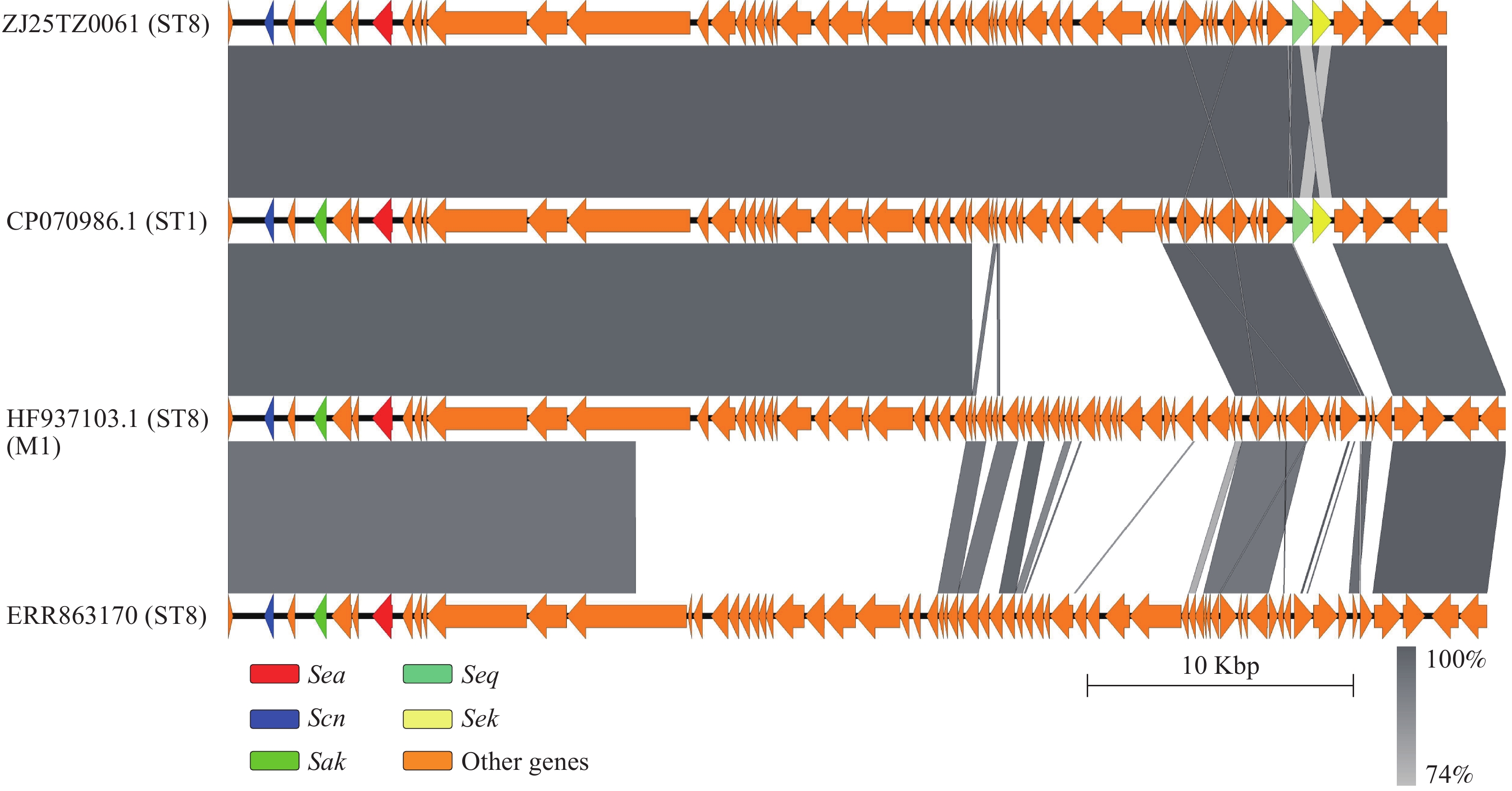 Figure 1.
Comparative analysis of the prophage structure in strain ZJ25TZ0061 and other S. aureus prophages.
Note: Arrows and arrowheads represent ORFs and transcriptional direction, respectively. Gray shading indicates nucleotide sequence similarity across the compared regions.
Abbreviation: ORF=open reading frame.
Furthermore, whole-genome single-nucleotide polymorphism (wgSNP) analysis revealed minimal genetic variation (3–12 SNPs) among the five S. aureus isolates (Table 1). A core-genome SNP (cgSNP)-based phylogenetic tree incorporating 76 global ST8 sequences placed all five outbreak strains on a distinct evolutionary branch (Clade II.1), separate from other isolates (Figure 2). These genomic analyses confirmed that the outbreak isolates originated from a common source.
Isolates number ZJ25TZ0061 ZJ25TZ0063 ZJ25TZ0064 ZJ25TZ0062 ZJ25TZ0065 ZJ25TZ0061 0 3 3 5 7 ZJ25TZ0063 3 0 6 8 10 ZJ25TZ0064 3 6 0 6 10 ZJ25TZ0062 5 8 6 0 12 ZJ25TZ0065 7 10 10 12 0 Note: The red-to-green color gradient represents increasing single-nucleotide polymorphism differences between isolates. Table 1. Overview of whole-genome single-nucleotide polymorphism differences among the five S. aureus isolates.
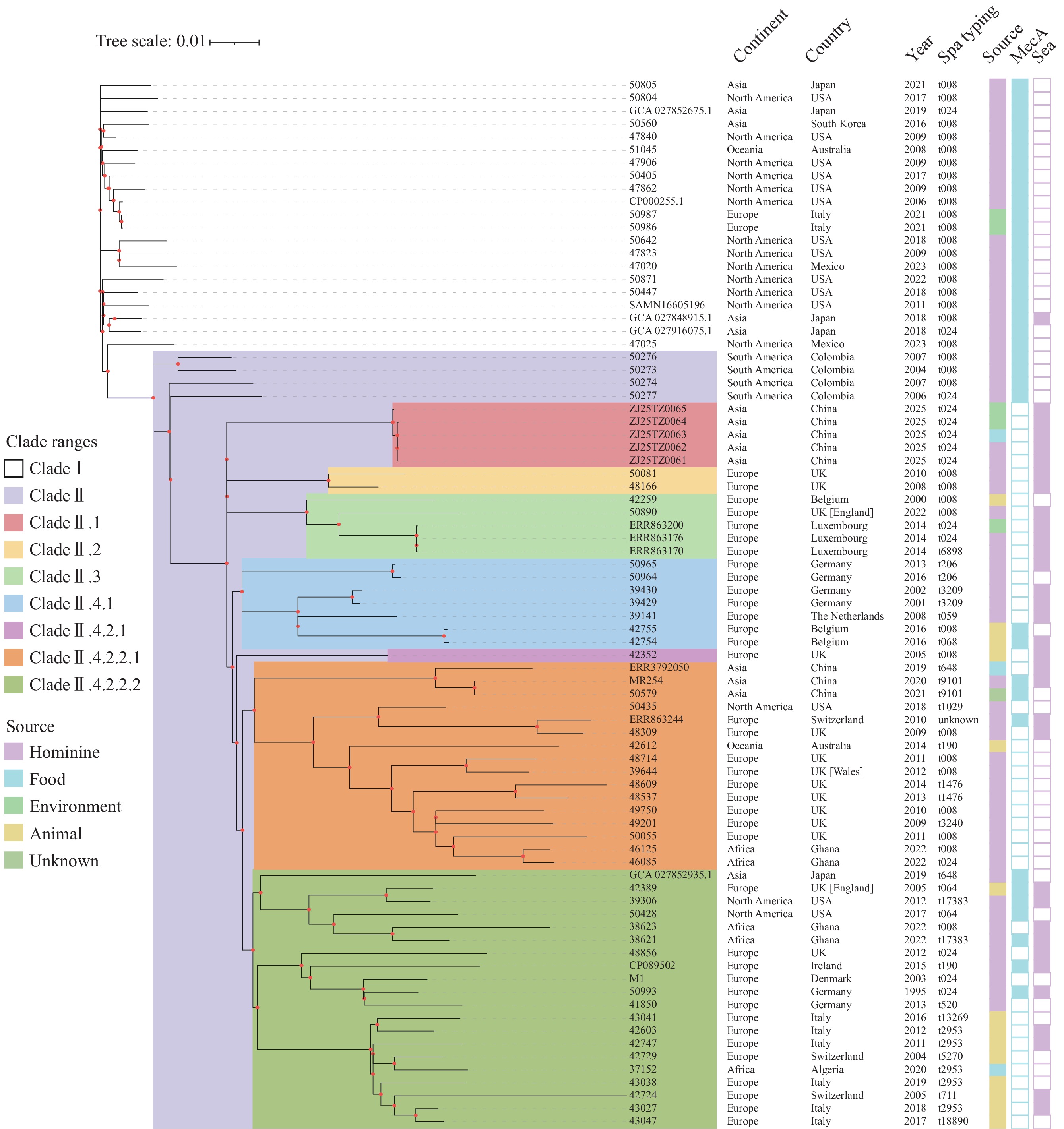 Figure 2.
Phylogenetic reconstruction of ST8 lineages based on core-genome single-nucleotide polymorphisms.
Note: This phylogenetic analysis incorporated 81 ST8 sequences, comprising 5 isolates from the present study and 76 reference sequences retrieved from the PubMLST, NCBI, DDBJ, and ENA databases. The Taizhou ST8 isolates are highlighted in rose pink for visual distinction. The fully sequenced ST8 S. aureus strain NCTC 8325 (GenBank accession no. NC_007795.1) was used as the reference genome for comparative analysis. Filled squares denote the presence of specific genes, while empty squares indicate their absence, as detailed in the column headers. Clade designations and geographic origins of all 81 isolates are displayed on the left side of the phylogenetic tree.
Abbreviation: USA=United States of America; UK=United Kingdom; NCBI=National Center for Biotechnology Information; DDBJ=DNA Data Bank of Japan; ENA=European Nucleotide Archive.
Integration of clinical manifestations, epidemiological data, laboratory findings, and genomic sequencing results identified the causative agent of this foodborne illness outbreak as ST8-spa t024 methicillin-susceptible S. aureus (MSSA) harboring enterotoxin genes sea, seq, and sek.
-
Following outbreak identification, the County CDC implemented comprehensive control measures. These interventions included thorough disinfection of all food preparation surfaces and tableware, enforcement of proper food storage protocols and cooking temperature requirements, mandatory school cafeteria self-inspection procedures, intensive training programs for food handlers emphasizing personal hygiene practices and environmental disinfection protocols, and enhanced medical surveillance systems to enable rapid detection and response to potential secondary cases.
-
Data from China’s National Foodborne Disease Outbreak Surveillance System indicate that S. aureus ranks as the third-most common bacterial cause of foodborne illness (5). This pathogen produces various staphylococcal enterotoxins (SEs) and SE-like toxins that mediate disease. Among these toxins, SEA, SEB, SEC, SED, and SEE represent the most prevalent enterotoxins; notably, prophages encode the SEA and SEB enterotoxins.
Multiple lines of evidence establish that contaminated rice balls prepared by an infected kitchen staff member caused this outbreak. First, all affected individuals consumed rice balls at breakfast and subsequently developed symptoms following a short, consistent incubation period characteristic of S. aureus food poisoning (SFP). Second, S. aureus strains isolated from the kitchen staff member, environmental surfaces, and rice ball samples confirmed the contamination source. Third, all five isolated strains produced enterotoxin A. Fourth, whole-genome phylogenetic analysis demonstrated that the outbreak strains clustered closely within evolutionary Clade II.1 of the ST8 genomes. Furthermore, the 3–12 single-nucleotide polymorphism (SNP) differences among the five isolates fell well below the 28 SNP threshold for defining outbreak-related strains (6), confirming their common origin.
The predominant pathogenic clonal complexes (CCs) associated with SFP in China include CC7, CC1, CC5, CC398, CC188, CC59, CC6, CC88, CC15, and CC25, with MSSA representing the majority of these strains (7). Our investigation identified the causative agent as an ST8-spa t024 MSSA strain harboring the sea, seq, and sek genes. Previous epidemiological studies have documented substantial geographic variation in ST8 S. aureus distribution: this clone predominates among CA-MRSA isolates in the United States, South America, Africa, and Europe. Conversely, ST8 S. aureus reports from Asia and the Asia–Pacific region remain limited, with only sporadic cases documented in Japan, South Korea, Pakistan, and Australia (8).
cgSNP-based phylogenetic analysis revealed that the outbreak ST8 strains formed a distinct evolutionary Clade II.1. These strains showed no close genetic relationship to the three previously reported domestic Chinese strains (ERR3792050, MR254, and ID 50579) in Clade II.4.2.2.1 (9–10); rather, they demonstrated close genetic relatedness to isolates from the United Kingdom (ID 48166 and ID 50081) in Clade II.2. These UK isolates were recovered from human blood samples in Europe in 2008 and 2010, respectively. This phylogenetic proximity suggests that the outbreak strains may have originated in Europe, potentially introduced through international human travel or global food supply chains.
The ST8 clone represents a globally disseminated, hypervirulent lineage predominantly associated with CA-MRSA, typically harboring virulence factors including enterotoxin genes, the Panton-Valentine leukocidin (PVL) gene, and the staphylococcal cassette chromosome mec (SCCmec) element. In this outbreak, however, the ST8-spa t024 strains were MSSA carrying enterotoxin genes sea, seq, and sek, along with IEC genes scn and sak, as well as the toxin gene lukDE. This virulence gene profile demonstrates that these MSSA strains possess characteristics typical of hypervirulent clones and may therefore pose a substantial public health threat.
Structural analysis of the prophage in strain ZJ25TZ0061, which harbors the type D IEC cluster (sea–sak–scn), revealed high sequence homology to prophages found in ST1(CC1) strains (represented by accession no. CP070986.1). This finding suggests that bacteriophages in SFP-associated strains may facilitate horizontal gene transfer across diverse ST/CC lineages. To elucidate this process more comprehensively, additional research should address two critical questions: how these genomic elements influence S. aureus pathogenicity, and what molecular mechanisms enable the horizontal transfer of the sea-prophage.
This outbreak represents the first documented emergence of a foodborne ST8-spa t024 MSSA clone in China, underscoring both the expansion of this lineage and its considerable pathogenic potential. These findings highlight the need for enhanced surveillance of CA-MSSA in asymptomatic carriers, particularly among food handlers, to strengthen food safety risk assessments and prevent future outbreaks.
HTML
| Citation: |

|