


 Download:




-
Infectious diseases continue to pose a formidable and evolving threat to global health security, as exemplified by the persistent emergence or resurgence of infectious disease outbreaks worldwide. Against this backdrop, establishing surveillance systems with broad-spectrum pathogen coverage and proactive early-warning capabilities has become essential for implementing targeted public health interventions. Environmental monitoring technologies have achieved large-scale applications over the past decade in tracking pathogen transmission dynamics and predicting outbreak risks by leveraging their unique strengths in unbiased population screening and early signal capture, driven by significant advancements in high-sensitivity molecular detection techniques. Among innovative surveillance strategies, wastewater surveillance based on wastewater-based epidemiology (WBE) theory has emerged as a particularly effective approach, characterized by its rapid, non-invasive, and scalable nature. This methodology provides objective, real-time, and cost-effective public health risk information within defined geographical areas (1). In response to the COVID-19 pandemic, 72 countries implemented wastewater surveillance for early outbreak detection and ongoing epidemiological monitoring (2). The Netherlands pioneered the first national wastewater surveillance framework for COVID-19 in early 2020, with sampling from 352 wastewater treatment plants (WWTPs) covering nearly all residents (3). Building on this advancement, the United States operationalized a nationwide wastewater surveillance system in September 2020, demonstrating dual functionality in both early outbreak detection and real-time data provision for localized public health decision-making. This system encompassed 1,567 sites at WWTPs or upstream locations (4). To complement existing population symptom-based surveillance (5), China launched the Chinese urban wastewater surveillance system (CWSS) to enhance national early monitoring and warning capabilities. Initiated in January 2023 under the auspices of the National Disease Control and Prevention Administration, the China CDC established this network across strategically selected cities nationwide to monitor and assess COVID-19 epidemic intensity, transmission dynamics, viral mutations, and other public health threats, both domestically and internationally. Throughout its operation, the CWSS has contributed significantly to the surveillance, prevention, and control of COVID-19, polio, monkeypox, and other epidemics. This report summarizes the implementation and efficacy of the CWSS from January 2023 to June 2025.
-
The CWSS surveillance system integrated three complementary operational components: 1) National urban wastewater surveillance: a network spanning 833 WWTPs across 169 cities, implementing semi-weekly 24-hour composite sampling at the facility inlets for severe acute respiratory syndrome coronavirus 2 (SARS-CoV-2) detection and monthly poliovirus monitoring at designated sites. 2) Inbound international aircraft wastewater surveillance: weekly grab sampling from international flights arriving at 44 cities, with priority given to routes originating from high-risk countries and regions to enable early detection of SARS-CoV-2 variants and monkeypox lineages. Additionally, 12 cities expanded their surveillance capabilities to include targeted monitoring of highly pathogenic agents, specifically Ebola virus, Marburg virus, Yellow fever virus, MERS-CoV, and Dengue virus. 3) Urban wastewater public health risk surveillance: 13 pilot cities established 169 surveillance points that combined 24-hour composite sampling from WWTPs with sampling from strategically selected urban locations (e.g., hospitals, wet markets, and residential clusters) to simultaneously detect and quantify influenza virus, norovirus, toxigenic Vibrio cholerae, Salmonella spp., antimicrobial resistance genes (ARGs), pharmaceuticals related to infectious diseases (PRID, including antipyretics, analgesics, antibiotics, and psychotropics), and emerging threats such as Disease X. This comprehensive approach enabled robust population-level epidemiological trend analysis and antimicrobial resistance risk assessment. The CWSS network continues to expand, with the spatial distribution of surveillance sites illustrated in Figure 1.
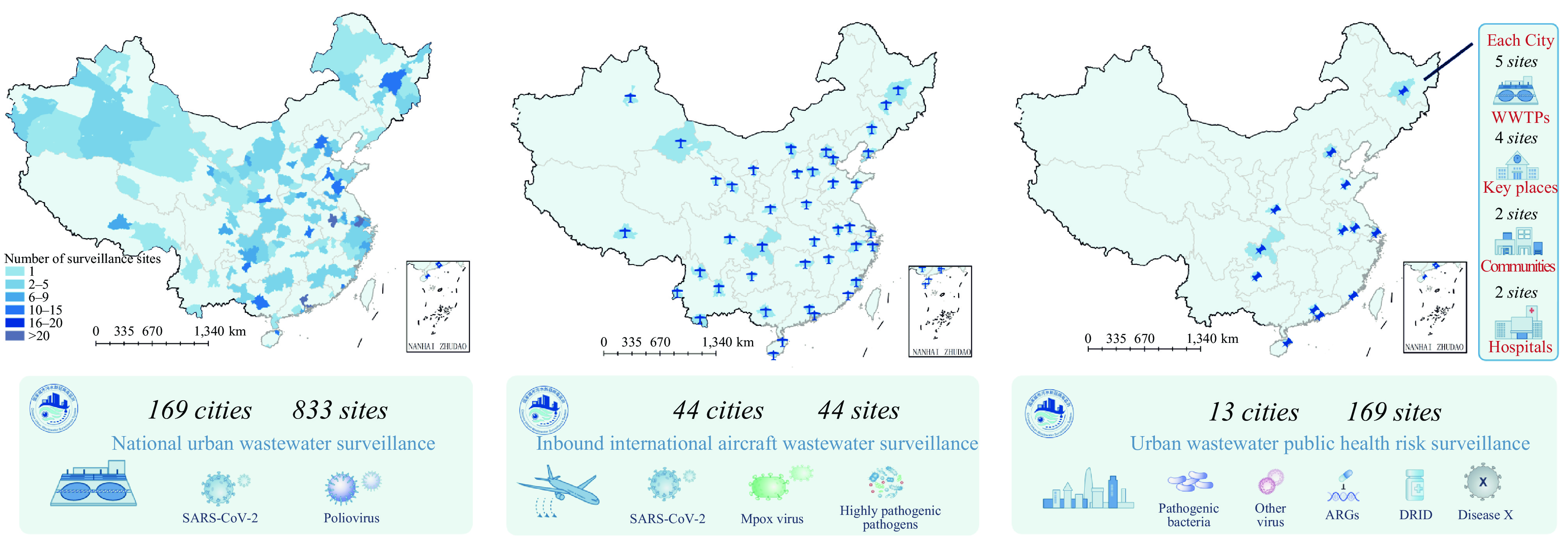 Figure 1.
Geographic distribution of wastewater surveillance sites in the CWSS, January 2023–June 2025. (A) Geographic distribution of National urban wastewater surveillance sites; (B) Geographic distribution of Inbound international aircraft wastewater surveillance sites; (C) Geographic distribution of Urban wastewater public health risk surveillance sites.
Note: Each point represents an individual surveillance site. Key locations include bars, public bathhouses, retail supermarkets, and wet markets.
Map approval number: GS京(2025)2199号.
Abbreviation: ARGs=antimicrobial resistance genes; PRID=pharmaceuticals related to infectious diseases; CWSS=Chinese Urban Wastewater Surveillance System.
-
The CWSS received primary funding through central government appropriations, with local CDC departments coordinating sample collection, physicochemical analysis, and laboratory testing. Wastewater samples underwent enrichment and concentration procedures before reverse transcription polymerase chain reaction (RT-PCR) testing. Samples meeting eligibility criteria (Ct≤34) subsequently proceeded to genomic sequencing. Comprehensive laboratory outputs — including monitoring site information, physicochemical indicators, qualitative and quantitative viral nucleic acid results, and sequencing data — were uploaded to the China CDC surveillance platform for integrated analysis. Using SARS-CoV-2 as an exemplar, the surveillance system generated three key indicators: 1) the positive rate of viral nucleic acids in wastewater, reflecting the proportion of infected catchment areas; 2) the flow-weighted average of viral nucleic acid concentrations in wastewater, reflecting infection prevalence intensity; and 3) viral genotype classification with composition ratios, identifying predominant pathogen strains. These indicators provided the foundation for epidemic trend analysis and informed targeted public health interventions. Upon detecting anomalous data fluctuations or emergent variants, the system initiated immediate verification protocols with local CDC departments for comprehensive risk assessment. Confirmed abnormal signals triggered formal risk evaluations, alert issuance, and recommendations for responsive countermeasures. The complete operational workflow of the surveillance system is illustrated in Figure 2.
 Figure 2.
Chinese urban wastewater surveillance flowchart.
Abbreviation: SS=suspended solids; COD=chemical oxygen demand; TN=total nitrogen. -
After two years of systematic implementation, the CWSS has matured into an integrated, agile, and highly responsive surveillance platform, generating over 200,000 data points that have proven instrumental in epidemic monitoring and early warning efforts. The continuous evolution of the CWSS has advanced methodological innovation in wastewater-based pathogen detection while simultaneously strengthening disease control capabilities across all tiers of the CDC organizational structure. Collectively, these advancements have established a robust foundation for rapid and effective responses to both current and emerging infectious disease threats.
-
The CWSS has emerged as a critical tool for real-time monitoring of epidemiological dynamics and providing proactive early warnings for SARS-CoV-2, poliovirus, monkeypox virus, influenza, norovirus, and other pathogens. Using SARS-CoV-2 as a representative case, the CWSS employed a calibrated baseline methodology to establish risk thresholds based on quantitative wastewater pathogen load data, enabling scientific anomaly identification and comprehensive risk assessment. The spatiotemporal patterns of SARS-CoV-2 nucleic acid concentrations in urban wastewater revealed trajectories corresponding to four epidemic waves occurring in May and August 2023, and March and July 2024. These wastewater-derived patterns not only mirrored the peak incidence periods identified through conventional population-based surveillance but also provided the earliest objective signals of epidemic attenuation. Continuous, high-resolution spatiotemporal monitoring demonstrated that fluctuations in SARS-CoV-2 nucleic acid concentrations in wastewater exhibited statistically significant correlations with epidemiological trends observed in population surveillance findings (R2=0.47). Correlation analyses revealed that wastewater surveillance could anticipate shifts in epidemic trends by 2–3 days relative to traditional population monitoring in Beijing (R2=0.70–0.76) (6). The integration of these quantitative concentration measurements into surveillance frameworks has substantially enhanced the predictive and early warning capacities of public health authorities, enabling the implementation of precisely targeted and timely intervention strategies.
-
Wastewater surveillance enabled comprehensive identification of viral variants, providing critical real-time insights into viral evolution, transmission dynamics, and potential outbreak trajectories. For example, in February 2023, municipal WWTPs successfully detected the XBB.1.5 variant of SARS-CoV-2 — an internationally circulating strain not yet identified through domestic clinical surveillance — at a regional treatment facility. This environmental detection preceded the first local clinical case report by three days, immediately triggering targeted epidemiological investigations and intensified sentinel surveillance. The 72-hour lead time proved critical for implementing containment strategies and mitigating community transmission risk. Through strategic monitoring of high-risk venues (e.g., bars, clubs, and bathhouses) across selected pilot cities, wastewater surveillance detected monkeypox virus (subtype C1Ⅱb) on three occasions at a male bathing facility, successfully pinpointing a localized cluster and informing targeted public health interventions (7). Furthermore, proactive surveillance for novel pathogens via genome sequencing in wet market and community wastewater led to the identification of A/H5N6 avian influenza virus, which had not been detected in local human surveillance prior to this investigation. This pivotal finding immediately activated public health risk notification mechanisms, providing essential supplemental data to both human health and agricultural monitoring programs. Additionally, toxigenic Vibrio cholerae was isolated from hospital wastewater, including a strain of the O1 serogroup, prompting comprehensive population-based epidemiological investigations and case tracing efforts. Following expansion of the surveillance system, the number of poliovirus strains isolated in the past four months doubled compared to the cumulative total from previous years. This substantial increase underscored the enhanced sensitivity of wastewater-based surveillance over traditional case-based methods, thereby elevating both the predictive power and early warning capacity of infectious disease monitoring systems.
-
To address methodological challenges in SARS-CoV-2 wastewater surveillance, the CWSS project team systematically developed, validated, and implemented three enrichment and concentration methods: polyethylene glycol (PEG) precipitation, aluminum salt precipitation, and centrifugation with ultrafiltration. These protocols were published in March 2022 as the “Standard Method for Enrichment and Nucleic Acid Detection of SARS-CoV-2 in Sewage” (8), establishing a unified technological foundation for nationwide SARS-CoV-2 wastewater monitoring. Throughout implementation, the team continuously refined enrichment, concentration, nucleic acid detection, and variant identification protocols, achieving substantial improvements in detection sensitivity, viral recovery rates, and analytical accuracy (9). A comprehensive standardized operational framework was developed through iterative expert consultations and integration of field-derived empirical evidence. This structured framework encompassed nine core operational components: sample collection protocols, biohazard transport logistics, laboratory analytical procedures, data reporting architecture, quality assurance protocols, data analysis methods, risk stratification algorithms, bioinformatics pipelines, and emergency response cascades.
-
A nationwide wastewater-based pathogen surveillance information system has been established to facilitate end-to-end digital management of data acquisition, transmission, and analysis through a dual-coding framework (site-specimen ID mapping). This platform enables systematic aggregation across three critical surveillance domains: 1) pathogenic profiles (including viral load quantification and variant subtyping), 2) pharmaceutical residues, and 3) antimicrobial resistance gene (ARG) profiling. By integrating wastewater pathogen monitoring data with clinical case reports and multi-source factors influencing disease outbreaks — including meteorological and environmental variables — the system employs epidemiological, statistical, and ecological analytical approaches to predict and provide early warnings of potential infectious disease outbreaks through multi-dimensional datasets. The architecture incorporates an automated validation rule repository with a three-tier verification protocol (field-, provincial-, and national-level) to enable real-time dynamic tracking and accurate analysis of core metrics, such as spatiotemporal distribution of key variants and longitudinal trends in viral concentrations. This integrated system delivers rapid, sensitive, and intelligent monitoring capabilities that encompass data management, risk assessment, and outbreak prediction.
-
The CWSS has substantially strengthened provincial and municipal CDC laboratory capabilities through a multifaceted capacity-building strategy encompassing specialized training programs, collaborative research initiatives, and nationwide proficiency testing with blinded wastewater samples. This systematic framework has enhanced pathogen detection sensitivity, upgraded analytical instrumentation infrastructure, and established wastewater surveillance as a cornerstone of infectious disease monitoring systems. The platform has further optimized cross-source data integration, refined early warning algorithms, and progressively enhanced predictive modeling capabilities for priority infectious diseases through continuous wastewater pathogen surveillance. To ensure sustained operational excellence and provide strategic guidance, the CWSS established the National Urban Wastewater Monitoring Project Expert Advisory Committee, comprising 13 distinguished scholars representing diverse disciplines including environmental health, microbiology, infectious disease epidemiology, bioinformatics, and biostatistics.
-
The effectiveness of infectious disease early warning systems fundamentally depends on their sensitivity and timeliness in detecting unusual increases or clusters of infections (10). In this regard, wastewater surveillance has emerged as an indispensable and transformative epidemiological tool. This approach excels in identifying viral variants and providing early warnings, thereby effectively monitoring population infection trends and epidemic inflection points. By generating high-frequency, real-time data, it supports evidence-based public health decision-making. Compared to traditional individual surveillance, wastewater surveillance reduces reliance on clinical case detection, circumvents the high costs of large-scale screening, and alleviates pressure on healthcare resources. Compared to wastewater surveillance systems in other countries, CWSS integrates municipal WWTPs, international flights, and high-risk venues into a cohesive multi-scenario surveillance framework. This integrated design addresses common fragmentation issues in multi-jurisdictional settings. The system’s ability to track multiple priority pathogens simultaneously enhances surveillance efficiency. Additionally, the standardized technical protocols underpinning CWSS have been rigorously validated in over 120 cities, demonstrating a replicable and scalable model for broader implementation. Given its proven utility, the CWSS network continues to expand, comprising 1,076 monitoring sites as of June 2025, a scale that strengthens its capacity for monitoring emerging and re-emerging infectious diseases across diverse settings.
However, the findings in this report are subject to several key limitations. First, monitoring processes need further optimization in terms of standardization and normalization. Temporal variability in disease prevalence and inconsistencies in sampling, methodology, and equipment hinder cross-regional and temporal comparisons of pathogen concentrations in wastewater. Second, multi-pathogen detection requires technological innovation, with current methods focusing on known pathogens and lacking sensitivity. High-throughput detection is underdeveloped, and identifying unknown pathogens remains in its early stages. Third, data analysis and early warning capabilities need improvement. The interdisciplinary nature of wastewater surveillance creates challenges in obtaining comprehensive data, and advanced technologies like AI and machine learning are underutilized. Effective guidelines for integrating diverse data sources for early warning are needed.
Building on CWSS’s current foundation, future strategic developments will focus on seven key priorities: 1) Standardizing sampling and testing protocols for consistent data across sites and periods; 2) Enhancing surveillance at critical points of entry (e.g., airports, hospitals) to detect and contain outbreaks; 3) Implementing region-specific protocols that prioritize local pathogens and public event impacts; 4) Advancing multi-pathogen detection for rapid, sensitive surveillance in wastewater; 5) Incorporating AI-driven, dynamic Bayesian networks and machine learning for predictive early warning and risk classification, and for optimizing thresholds; 6) Addressing technical bottlenecks (e.g., RNA loss) and integrating next-generation sequencing (NGS) technologies for real-time pathogen detection; 7) Balancing public health and privacy with a governance framework ensuring voluntary interventions rather than individual tracking. These improvements will strengthen China’s predictive and early warning capabilities for infectious diseases, supporting a robust, responsive monitoring system.
-
Wastewater surveillance represents a critical and transformative tool for public health early warning. The CWSS framework provides a model that is efficient, flexible, fair, operational, sustainable, and policy-relevant, by virtue of its integrated multi-scenario design and capacity for simultaneous multi-pathogen tracking, making it suitable for nationwide implementation. Therefore, advancing and institutionalizing such systems is essential to substantially strengthen predictive capabilities and early warnings for major infectious diseases. This integrated approach offers fundamental scientific support for establishing a robust, intelligent, multi-point-triggered, and responsive national infectious disease monitoring and early warning system in China.
-
The invaluable support and contributions of the local CDC organizations in each surveillance city, whose dedicated efforts were essential to the successful implementation of this nationwide surveillance system.
HTML
System Architecture and Components
Operational Workflow and Mechanisms
System Performance and Impact
Forecasting infectious disease epidemic trends.
Timely warning of virus variants.
Promoting standardization of monitoring techniques.
Developing an integrated data management system.
Advancing testing capacity in CDC organizations.
| Citation: |

|